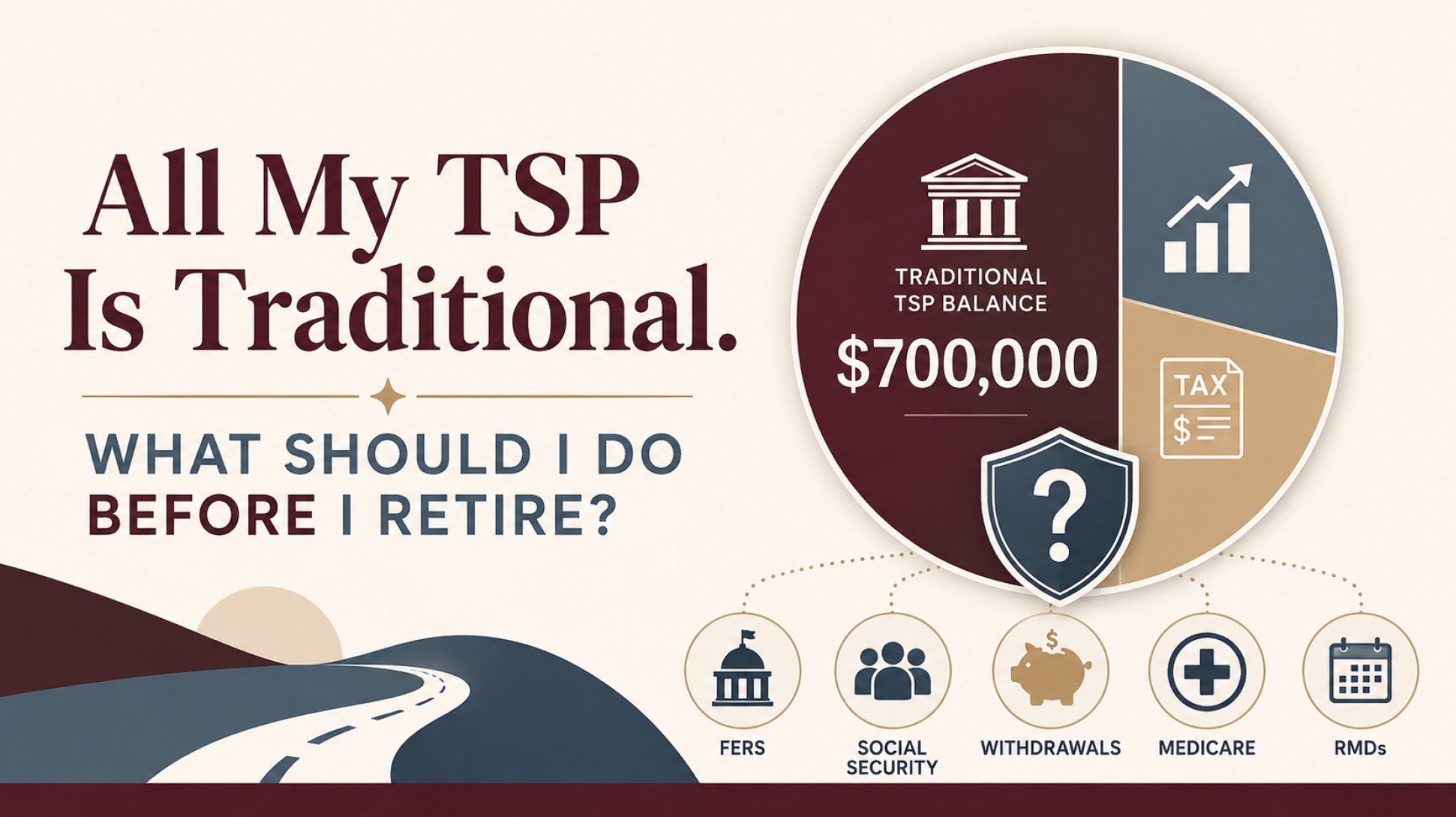
All My TSP Money Is Traditional. What Should I Do Before I Retire?
Last Updated: September 7, 2026
Written by Lisa Y. Jones, Wealth Strategist and Financial Educator
If all or most of your TSP is Traditional, the answer is usually not “move it all” or “leave it all.” A better strategy is to decide what portion should stay tax-deferred, what portion may make sense to convert to Roth over time, and what portion may be better positioned for income, liquidity, or protection. That decision is often most useful before retirement, while more options may still be available.
For years, you were told to save, contribute to your TSP, get the match, keep investing, and let it grow. And that was good advice.
But retirement changes the assignment.
You are no longer just trying to build the biggest account balance you can. Now the conversation shifts to how that money may become income, how much of it could be taxable, how accessible it will be when life happens, and how much control you want over your money later.
That is why I do not look at a large Traditional TSP and automatically think, “Great, leave it alone.”
I also do not automatically think, “Convert the whole thing to Roth.”
The better question is: What job does each part of this money have in your retirement?
Your TSP Balance Is Not the Same as Your Spendable Retirement Money
Let’s say you are 62, single, and getting ready to retire from federal service with $700,000 in your Traditional TSP.
That sounds like a strong number. And it is.
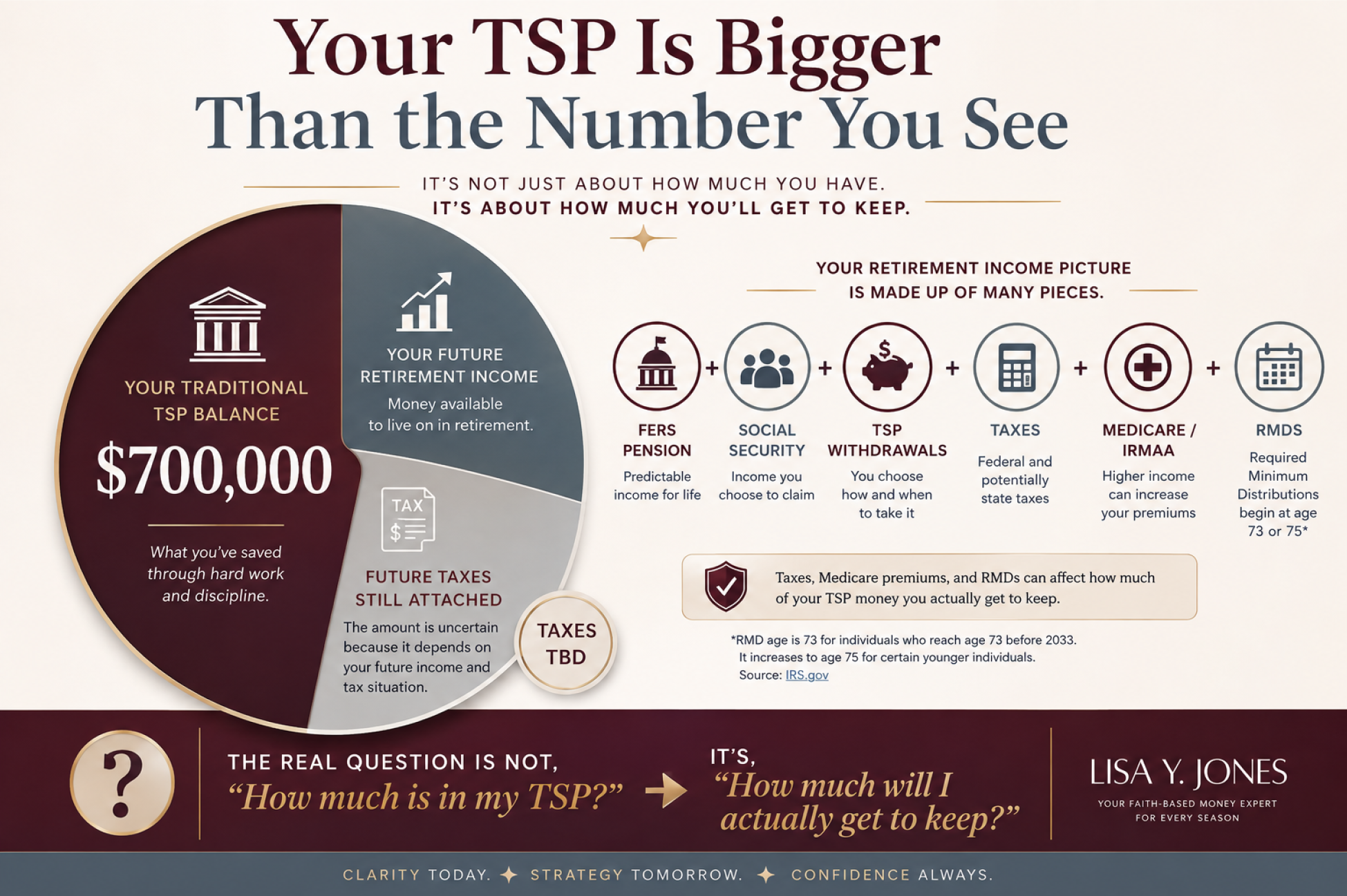
But the $700,000 on your statement is not the same thing as $700,000 sitting in a checking account waiting for you to spend.
Traditional TSP money has not yet been taxed. When taxable distributions begin, those withdrawals generally become part of your taxable income.
So the more useful question is not simply, “How much is in my TSP?”
It is, “How much of my TSP can I actually use after taxes, and what happens when those withdrawals are combined with everything else?”
In retirement, your TSP becomes part of a much bigger picture. Your FERS pension may already be coming in, Social Security may begin a few years later, and there may also be income from an IRA, investments, rental property, or part-time work. Once Medicare enters the picture, income can affect more than the tax return.
Looking at those pieces together before retirement can create a very different picture than making the TSP decision by itself.
“I Thought I Would Be in a Lower Tax Bracket After I Retire”
You might be.
But I would not build a retirement strategy around that assumption.
Your salary may disappear when you retire, but that does not mean your taxable income disappears with it. Income may still come from your FERS pension, Social Security, Traditional TSP withdrawals, interest, dividends, consulting work, or rental property.
OPM explains that a portion of a FERS annuity is generally taxable, while another portion represents the return of contributions that were already taxed. You can review OPM’s tax information for federal annuitants here.
So retirement is not as simple as, “My paycheck is gone, so my taxes will be lower.”
Sometimes they are. Sometimes they are not.
And if you are a single woman with a substantial Traditional TSP, that distinction can matter because all of those income decisions eventually come together on one tax return.
Looking at the structure of the money before retirement may reveal choices that are harder to see once retirement income is already flowing.
A Better Way to Think About Your Traditional TSP
Instead of asking whether you should move your entire TSP, I would start with what the money is supposed to accomplish.
Part of it may stay positioned for long-term growth because retirement could last decades. Another portion may make sense for dependable retirement income or for reducing how much of your lifestyle depends on the stock market. And having accessible money outside of market-based investments can make a big difference when a new roof, family emergency, or large medical expense shows up.
That does not mean every retiree should own three products or maintain three specific accounts.
It simply means retirement money often has more than one job.
If every dollar sits in the same tax category, carries similar market exposure, and follows the same withdrawal rules, there may be fewer choices available than the account balance suggests.
That is where the planning conversation starts.
Some of Your Money May Make Sense Staying Traditional
There is nothing inherently wrong with Traditional TSP money.
I want to say that clearly because retirement conversations can quickly turn into “Traditional is bad, Roth is good.”
It is not that simple.
Keeping part of your money in the Traditional TSP may make perfect sense. You may not plan to use that money for years. You may like the investment options available inside the TSP. You may be in a higher tax bracket today than you expect to be later. Or creating a large tax bill right now may simply not work in your favor.
The goal is not to empty a Traditional TSP because somebody created fear around future taxes.
A more useful question is how much tax-deferred money makes sense to carry into retirement given the rest of your financial picture.
There is a big difference between saying, “I chose to keep this portion Traditional because it supports my plan,” and saying, “I left everything there because I never really thought about it.”
Some May Make Sense Converting to Roth Over Time
This is one place where 2026 gave federal employees a new option.
Beginning January 28, 2026, eligible TSP participants can convert money from a Traditional TSP balance to Roth TSP through a Roth in-plan conversion. You can review the TSP’s official Roth in-plan conversion guidance here.
That does not mean converting everything suddenly becomes the best answer.
It simply gives federal employees another tool to evaluate.
When pre-tax Traditional money is converted to Roth, the amount converted generally becomes taxable income for that year. TSP also requires the taxes associated with the conversion to be paid from funds outside the conversion itself.
So imagine a $700,000 Traditional TSP.
Paying tax on all $700,000 in one year may make very little sense. But converting a portion over several years could tell a completely different story.
That is why I tend to think about Roth conversions as a multi-year strategy, not a one-day event.
The goal is not to get every dollar into Roth as quickly as possible.
The real question is whether paying some tax intentionally during certain years could create greater flexibility later.
Your Medicare Timeline Matters Too
This is where timing becomes even more important.
A large Traditional TSP withdrawal or Roth conversion can increase modified adjusted gross income. Medicare uses that income to determine whether an Income-Related Monthly Adjustment Amount, commonly called IRMAA, applies to Medicare Part B and Part D.
Medicare generally looks at income from two years earlier when determining those premiums. You can review Social Security’s Medicare premium guidance here.
So a financial decision made before Medicare begins can still follow you into Medicare.
That does not mean avoiding Roth conversions because of IRMAA.
It means timing deserves to be part of the conversation.
There may be years when a conversion works better than others. A smaller conversion could accomplish the goal without creating an unnecessary ripple effect. Or another source of money may be available for a particular expense instead of creating a large taxable withdrawal.
The more options available, the more control you may have over how those decisions affect each other.
And Some of Your Money May Have a Completely Different Job
This is the part that often gets missed when every TSP conversation becomes a debate about Traditional versus Roth.
Taxes are important, but taxes may not be the only issue.
Maybe nearly all of your retirement savings are exposed to the market. If the market drops 25% during the first few years of retirement while withdrawals are also coming out to cover living expenses, that creates a very different challenge than a market drop at age 45 while contributions are still going in.
Or maybe your pension covers most of your basic expenses, but you would prefer another dependable source of monthly income.
Maybe liquidity is the bigger concern. Selling investments every time the house needs something, a family member needs help, or an unexpected expense appears may not be how you want retirement to work.
Long-term care or legacy may also be part of the picture.
Once those issues enter the conversation, the decision is no longer simply Traditional versus Roth.
Now the question becomes whether part of the retirement assets could be positioned differently because that money has another job.
That may lead to evaluating an annuity. It may lead to considering a properly structured cash-value life insurance strategy. It may simply mean creating a stronger cash reserve while leaving other assets invested for growth.
The appropriate solution becomes much clearer once the job of the money is clear.
That is why I start with the problem, not the product.
Consider a 62-Year-Old Single Federal Employee With a $700,000 Traditional TSP
Let’s make this practical.
Imagine a 62-year-old single woman who has spent 30 years in federal service. She has $700,000 in her Traditional TSP, expects a FERS pension, and plans to claim Social Security a few years into retirement.
She has done a good job.
She saved consistently. She received the match. She allowed the money to grow.
Her first instinct may be to leave everything exactly where it is because it has worked well for her so far.
And maybe keeping some or even much of it there will remain part of the answer.
But suppose her FERS pension will cover most of her monthly expenses, which means large TSP withdrawals may not be necessary immediately. Keeping part of the account invested for future growth could make sense.
At the same time, she may discover that almost all of her retirement savings are tax-deferred. Gradually converting part of the balance to Roth could begin creating another tax option for later.
Then she realizes she has plenty of money on paper, but very little outside retirement accounts that can be accessed without generating a taxable withdrawal. At that point, repositioning another portion for liquidity or protected income may become worth exploring.
Notice what happened.
We did not start by saying, “Move the TSP.”
We also did not say, “Leave it alone.”
We looked at what she was trying to accomplish and allowed different dollars to have different jobs.
That is a much more useful retirement conversation.
Required Minimum Distributions Can Eventually Make Some Decisions for You
There is another reason this conversation can be valuable before retirement.
At some point, the IRS may require distributions from tax-deferred retirement accounts whether that income is actually wanted that year or not.
Under current law, RMDs generally begin at age 73 for people who reach age 73 before 2033, with age 75 applying to certain younger individuals. You can review the current IRS RMD guidance here.
RMDs are not automatically bad.
But imagine retiring with a large Traditional TSP, taking relatively little from it for several years, and allowing the balance to continue growing. Once RMDs begin, those required withdrawals may add taxable income whether the money is actually required for spending or not.
That is why the years between retirement and RMD age can be particularly interesting.
For some people, those years may create an opportunity for Roth conversions while taxable income is lower. For others, they may offer an opportunity to reposition money gradually rather than waiting until required withdrawals begin.
Seeing that planning window ahead of time creates more room to evaluate the choices available.
What This Means for You
If most of your TSP is Traditional, the takeaway is not, “Lisa says I should convert my TSP.”
That is not what I am saying.
A more useful takeaway is:
“What job does each part of my TSP have once I retire?”
Some of the money may stay Traditional because continued tax deferral makes sense.
Some may be worth converting to Roth gradually to create another tax option later.
Some may be better positioned for income, liquidity, or protection because taxes are not actually the biggest concern.
And some may continue doing exactly what it has been doing, growing for the future.
Retirement changes the job of the money.
The way the TSP was accumulated does not automatically have to be the way it is distributed.
The Move I Would Not Make
I would not retire and immediately roll an entire TSP into an IRA simply because someone says that is what retirees are supposed to do.
I would not convert the entire account to Roth just because Roth sounds better.
And I would not put a large portion of retirement savings into an annuity simply because someone says retirees should have “safe money.”
Those are transactions.
A retirement strategy should come before the transaction.
The more useful starting point is understanding the income you want, what your pension and Social Security may provide, what your tax picture could look like, how much accessible money would make you comfortable, and how much market exposure fits the retirement you are building.
From there, it becomes much easier to evaluate what might stay, what might move, and what might change.
That is why my approach is simple:
Clarity first. Strategy second.
Frequently Asked Questions
Is it bad if all of my TSP is Traditional?
No. A large Traditional TSP does not mean you did anything wrong. In fact, consistently saving into your TSP may be one of the reasons you are in a strong position approaching retirement. The question now is whether keeping all of that money in one tax category still gives you the flexibility you want once you begin living on it.
Should I move all of my Traditional TSP to Roth before I retire?
An all-or-nothing decision is rarely the most useful place to start. A Roth conversion creates taxable income in the year of the conversion, so moving a large balance at once can create a substantial tax bill. Depending on your income and retirement timeline, smaller conversions over several years may be worth evaluating.
Can I convert Traditional TSP money to Roth without leaving the TSP?
Yes. Beginning January 28, 2026, eligible participants gained the ability to make Roth in-plan conversions from eligible Traditional TSP balances. You can review the official TSP guidance here.
Could a Roth conversion increase my Medicare premiums?
Potentially. A taxable Roth conversion increases income for the year of conversion, and Medicare uses modified adjusted gross income when determining whether IRMAA applies to Medicare Part B and Part D. That does not automatically make a conversion a bad idea, but it makes timing an important part of the decision.
Should I leave some money in the TSP after I retire?
You can, and for some retirees that may make sense. The more useful question is whether keeping part of the money in the TSP supports the job that portion of the money is intended to do. Some assets may remain positioned for growth while other assets handle current income, liquidity, or protection.
When do Required Minimum Distributions begin?
Under current law, RMDs generally begin at age 73 for individuals who reach age 73 before 2033, with age 75 applying to certain younger individuals. The exact rule depends on birth year and account type, so the applicable age is worth confirming as retirement approaches.
Your TSP Got You to Retirement. Now It Has a Different Job.
For most of your career, the goal was accumulation.
You earned the money, saved consistently, received the match, invested, and kept going.
Now the job is different.
Retirement money has to help create income, remain available when life happens, weather market downturns, work alongside a pension and Social Security, and do all of that without creating unnecessary tax consequences.
That is a very different assignment from simply watching the account balance grow.
The bigger question now is whether the money you spent decades accumulating is structured to support the life you are about to live.
Ready to See What Your TSP Could Look Like in Retirement?
If most of your retirement savings are sitting in a Traditional TSP, another generic retirement checklist probably will not answer the questions that matter most.
A Retirement Analysis looks at how your TSP, FERS pension, Social Security, taxes, Medicare, liquidity, and retirement-income goals work together.
The goal is not to move money for the sake of moving it. It is to see what may make sense to keep, what may be worth changing, and where greater flexibility could be created as retirement gets closer.
Explore Retirement Clarity with Lisa Y. Jones
Clarity first. Strategy second.
About Lisa Y. Jones
Lisa Y. Jones is a wealth strategist, financial educator, and #1 best-selling author of Financial Seasons. She helps federal employees and women approaching retirement understand how their TSP, retirement income, taxes, Social Security, Medicare, liquidity, long-term care, and legacy decisions work together.
Her approach begins with understanding what the money is intended to accomplish before evaluating products or repositioning retirement assets.
Primary Sources
Thrift Savings Plan Internal Revenue Service Social Security Administration Medicare U.S. Office of Personnel Management Retirement Center
Important Disclosure
This content is provided for educational purposes only and is not individualized tax, legal, investment, or financial advice. The appropriate strategy depends on age, income, tax situation, retirement date, benefits, assets, objectives, and other individual circumstances. Consult the appropriate qualified professionals before making tax or legal decisions or significant changes to retirement assets.