How Much Tax Will I Pay on Traditional TSP Withdrawals?
Last Updated: October 7, 2026
Written by Lisa Y. Jones, Wealth Strategist and Financial Educator
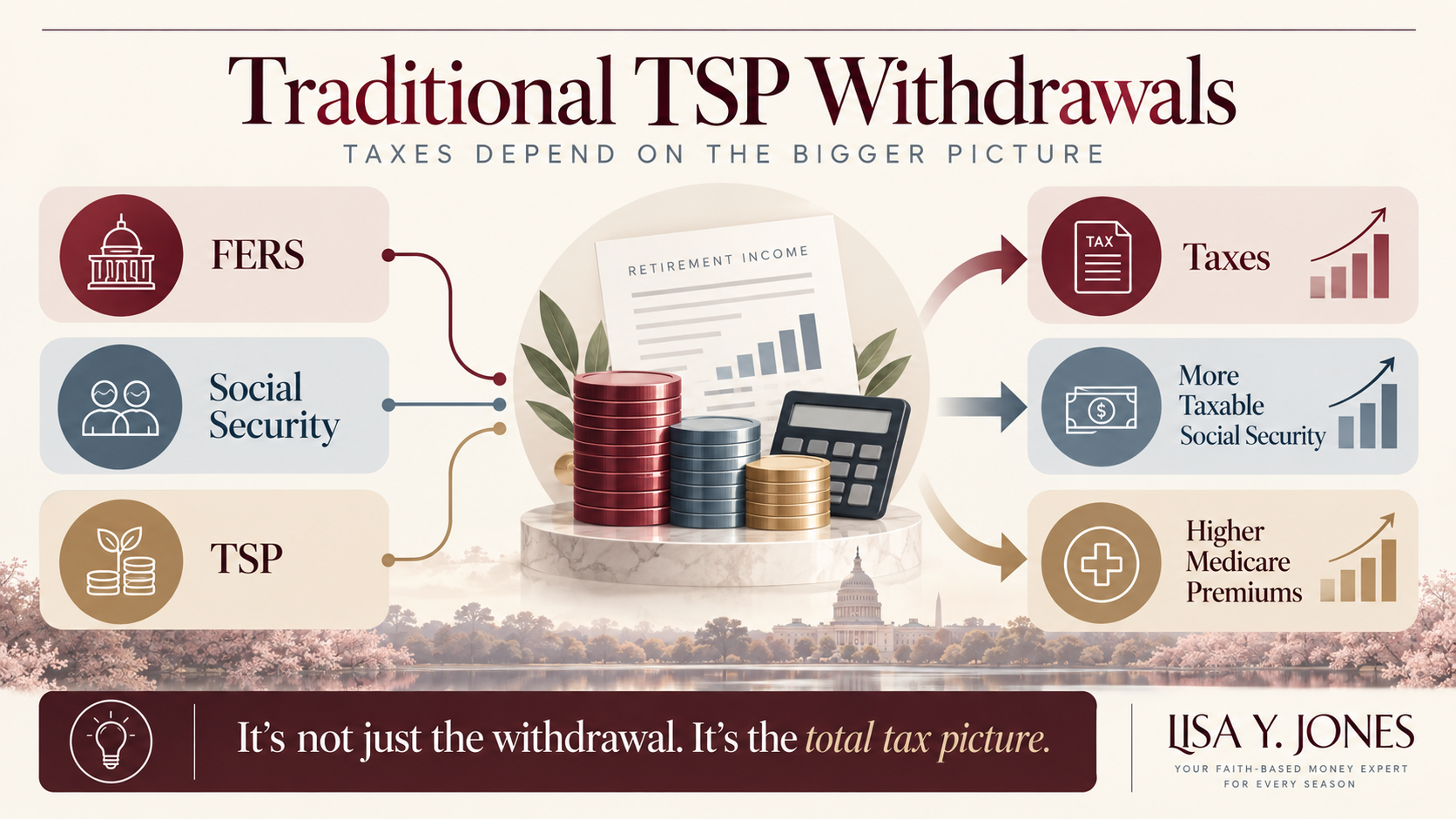
If you take money from your Traditional TSP in retirement, there is not one simple tax rate that applies to everyone. What you pay depends on what else is coming in that year, including your FERS pension, Social Security, filing status, and the size of the withdrawal. That is why the same $40,000 TSP withdrawal can create very different tax results for two different retirees.
And this is where people get tripped up.
A lot of folks assume, “I’m in the 22% tax bracket, so if I take $40,000 from my TSP, I’ll owe 22% of that.”
Not exactly.
That $40,000 does not sit off by itself. It gets added to the rest of your income, and that can change more than just the tax on the withdrawal.
It may also cause more of your Social Security to become taxable, move some of your income into a higher bracket, or affect Medicare premiums later.
So when someone asks me, “How much tax will I pay on a TSP withdrawal?” I am really looking at the whole picture.
Your TSP Withdrawal Becomes Part of the Rest of Your Income
Traditional TSP money was generally contributed before federal income tax was taken out. That was one of the benefits while you were working.
The tax was delayed.
It was not erased.
So when you take taxable money out of your Traditional TSP, that withdrawal generally becomes part of your taxable income for that year. You can review the IRS rules for retirement-plan distributions here.
That part is pretty straightforward.
The part that is not always obvious is what happens after that money gets added to your pension, Social Security, and anything else you may have coming in.
If most or all of your TSP is Traditional, this is also where the bigger retirement question begins. I break that down in All My TSP Money Is Traditional. What Should I Do Before I Retire?
There Is No Special “TSP Tax Rate”
This is an important distinction.
Your TSP does not have its own tax bracket.
The withdrawal is added to your other taxable income, and then the normal federal income tax brackets apply.
For 2026, a single filer has a standard deduction of $16,100. After that, taxable income moves through the regular federal tax brackets.
And being in the 22% bracket does not mean all of your income is taxed at 22%.
Part is taxed at 10%.
Part is taxed at 12%.
Then the next portion may be taxed at 22%.
That is why simply multiplying the withdrawal by your tax bracket can give you the wrong answer.
Let’s Put Some Numbers to It
Let’s say you are a 64-year-old single retired federal employee.
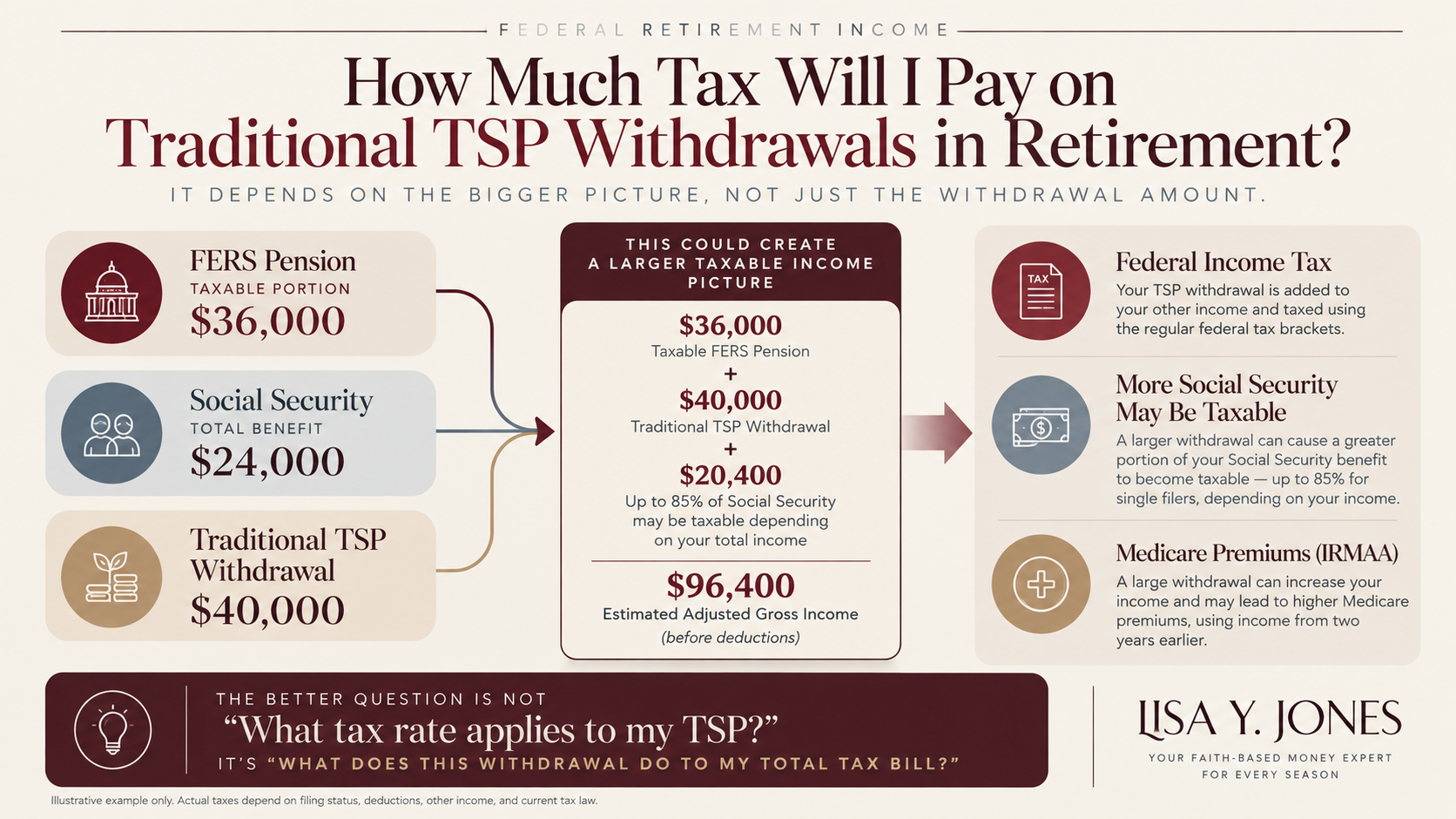
Your taxable FERS pension is $36,000 a year.
You receive $24,000 a year from Social Security.
And you decide to take $40,000 from your Traditional TSP.
At first glance, you may think:
“Okay, $36,000 pension plus $40,000 TSP. That gives me $76,000.”
But Social Security complicates the picture.
Depending on your income, part of your Social Security can become taxable. For a single filer, Social Security says that up to 85% of your benefit may be taxable once combined income goes above certain thresholds. You can review Social Security’s explanation here.
In this example, that $40,000 TSP withdrawal can cause more of the Social Security benefit to become taxable too.
So instead of thinking only about the $40,000 withdrawal, the tax return may now include the pension, the TSP withdrawal, and a larger taxable portion of Social Security.
That is the piece many people do not see coming.
So What Could the Tax Look Like?
Using this example, the approximate taxable income could look something like this:
The retiree has $36,000 of taxable pension income, a $40,000 Traditional TSP withdrawal, and about $20,400 of taxable Social Security.
That puts adjusted gross income around $96,400 before deductions.
After the 2026 standard deduction, taxable income would be roughly $80,300.
Based on current federal tax brackets, the estimated federal income tax would be around $12,400.
Now, I would not use that number to file a tax return. This is just an illustration.
But it makes the point.
The tax impact is not simply “22% of $40,000.”
The Withdrawal Can Trigger More Tax Somewhere Else
Here is the part I want you to notice.
Without the $40,000 TSP withdrawal, this retiree’s estimated federal tax would be much lower.
Once the withdrawal is added, not only does the $40,000 become taxable, but more of her Social Security may become taxable too.
So the withdrawal creates a ripple effect.
That is why I would rather ask:
“What happens to my total tax bill if I take this withdrawal?”
instead of:
“What tax rate applies to my TSP?”
Those sound similar, but they are not the same question.
Social Security Is Usually Where People Get Surprised
A lot of people assume Social Security is either taxable or not taxable.
It is actually more nuanced than that.
For a single filer, Social Security begins looking at combined income once it reaches $25,000, and up to 85% of benefits may become taxable once combined income rises above $34,000. Married couples filing jointly have different thresholds.
And just to be clear, when we say “85% taxable,” that does not mean the government takes 85% of your Social Security.
It means up to 85% of your benefit can be included as taxable income.
That is a very different thing.
A larger TSP withdrawal can push more of your Social Security into that taxable category.
Filing Status Can Change the Answer Quite a Bit
This is one reason I pay close attention to whether someone is single or married.
Two retirees can take the same $40,000 TSP withdrawal and have completely different tax results.
A single retiree may already have a FERS pension and Social Security using up more of the lower tax brackets.
A married couple filing jointly may have more room before the same withdrawal reaches the next bracket.
Same TSP withdrawal.
Different tax result.
That is why the amount of the withdrawal by itself does not tell the whole story.
Your FERS Pension Matters Too
Your FERS pension is also part of the calculation.
And it is not always true that the entire pension is taxable.
Part of your pension may be treated as a recovery of contributions you already paid tax on while working. OPM explains how the taxable and non-taxable portions of a federal annuity are handled. You can review OPM’s tax information here.
So when I am looking at retirement income, I care less about the gross pension number and more about the taxable portion.
That gives us a much cleaner picture of what the TSP withdrawal is really landing on top of.
A $20,000 Withdrawal and an $80,000 Withdrawal Tell Different Stories
This is where planning ahead can help.
Suppose the retiree in our example does not take $40,000.
Maybe she only takes $20,000.
That smaller withdrawal may leave more of her income in a lower tax bracket and may cause less of her Social Security to become taxable.
Now suppose she takes $80,000 because she wants to pay off the mortgage, renovate the house, or help a family member.
That could push even more income into a higher bracket and create a larger ripple effect.
So the question is not simply, “Can I take the money?”
Of course you can.
The more useful question is, “What does taking this amount this year do to everything else?”
Withholding Is Not the Same as Your Actual Tax Bill
This is another place where people get confused.
If taxes are withheld from your TSP withdrawal, that does not necessarily mean that is the final amount of tax you owe.
Think of withholding as a payment toward the eventual tax bill.
Depending on the type of distribution, different withholding rules may apply. You can review IRS withholding rules for pensions and retirement distributions here.
If $8,000 gets withheld from a $40,000 payment, that does not automatically mean the tax on the withdrawal was $8,000.
Once your full tax return is completed, the actual amount could be higher or lower.
That is why I would not use the withholding percentage as the retirement tax strategy.
And Then There Is Medicare
This is where a large withdrawal can follow you longer than you expect.
A Traditional TSP withdrawal increases taxable income, and that can also increase modified adjusted gross income.
Medicare uses that income to determine whether IRMAA applies to Medicare Part B and Part D.
And Medicare generally looks back two years.
So a large withdrawal at 63 can potentially show up again when Medicare premiums are calculated at 65.
That does not mean you should avoid taking money from your TSP.
It simply means the real cost of a withdrawal can be bigger than the tax you see in the year you take it.
Timing Can Matter Just as Much as the Amount
This is where retirement tax planning gets more useful.
Not every year in retirement looks the same.
You may have a year after you retire when your paycheck is gone but Social Security has not started yet.
You may have several years before Required Minimum Distributions begin.
You may have one year with unusually high income and another with very little.
Those differences can create opportunities.
A $40,000 withdrawal in a lower-income year may produce a very different tax result than the same $40,000 withdrawal after Social Security and RMDs have both started.
The withdrawal did not change.
The timing did.
And sometimes that is where the biggest planning opportunity sits.
What This Means for You
If you are trying to figure out how much tax you will pay on Traditional TSP withdrawals, the number on the withdrawal form is only one part of the answer.
What matters is what that withdrawal lands on top of.
If you already have a FERS pension, Social Security, or other taxable income, the withdrawal can affect more than one line on your tax return.
That is why I would rather look at a few different withdrawal amounts and compare the results before the money moves.
Maybe $20,000 works fine.
Maybe $40,000 still makes sense.
Maybe taking $80,000 in one year creates a tax result you would rather avoid.
The point is not to chase the lowest possible tax bill.
The point is to understand the tradeoff before making the move.
Frequently Asked Questions
How are Traditional TSP withdrawals taxed in retirement?
Taxable Traditional TSP withdrawals are generally included as ordinary income on your federal tax return. The actual amount of tax depends on your filing status, other income, deductions, and the size of the withdrawal.
Is there a flat 20% tax on TSP withdrawals?
No. Certain distributions may have 20% federal withholding, but withholding is not the same thing as your final tax rate. Your actual tax is calculated based on your full tax return.
Can a TSP withdrawal make more of my Social Security taxable?
Yes. A taxable TSP withdrawal can increase your combined income, which may cause a larger portion of your Social Security benefit to become taxable.
Is my entire FERS pension taxable?
Usually not. A portion of the pension may represent the return of contributions that were already taxed while you were working. OPM provides the rules for determining the taxable portion.
Does a larger TSP withdrawal automatically push me into a higher tax bracket?
Not always. It depends on where your taxable income already sits before the withdrawal. And even if part of the withdrawal reaches a higher bracket, only that portion is taxed at the higher rate.
Can I estimate the tax before taking the withdrawal?
Yes. An estimate can compare your pension, Social Security, TSP withdrawal, filing status, and other income before the money moves. That can make it much easier to compare different withdrawal amounts and different years.
The Better Question Is Not “What Is the Tax Rate?”
When someone asks me, “How much tax will I pay if I take $40,000 from my TSP?” I am not only looking at the $40,000.
I am looking at what is already coming in.
What does the pension look like?
Has Social Security started?
Is Medicare in the picture?
Is this a low-income year or a high-income year?
That is where the real answer lives.
The goal is not to make every withdrawal tax-free.
It is to understand what the withdrawal may trigger before the money moves.
Ready to See What Your TSP Withdrawals Could Actually Cost?
If most of your retirement savings are sitting in a Traditional TSP, knowing the account balance is only part of the story.
A Retirement Analysis can show how your TSP withdrawals may interact with your FERS pension, Social Security, federal taxes, Medicare, and the income you actually want available to spend.
The question is not simply:
“How much can I withdraw?”
A better question is:
“How much will I actually get to keep?”
Explore Retirement Clarity with Lisa Y. Jones
Clarity first. Strategy second.
About Lisa Y. Jones
Lisa Y. Jones is a wealth strategist, financial educator, and #1 best-selling author of Financial Seasons. She helps federal employees and women approaching retirement understand how their TSP, retirement income, taxes, Social Security, Medicare, liquidity, long-term care, and legacy decisions work together.
Her approach begins with understanding what the money is intended to accomplish before evaluating products or repositioning retirement assets.
Primary Sources
Social Security Administration
U.S. Office of Personnel Management Retirement Center
Important Disclosure
This content is provided for educational purposes only and is not individualized tax, legal, investment, or financial advice. The appropriate strategy depends on age, income, tax situation, retirement date, benefits, assets, objectives, and other individual circumstances. Consult the appropriate qualified professionals before making tax or legal decisions or significant changes to retirement assets.