Last Updated: October 25, 2026
Written by Lisa Y. Jones, Wealth Strategist and Financial Educator
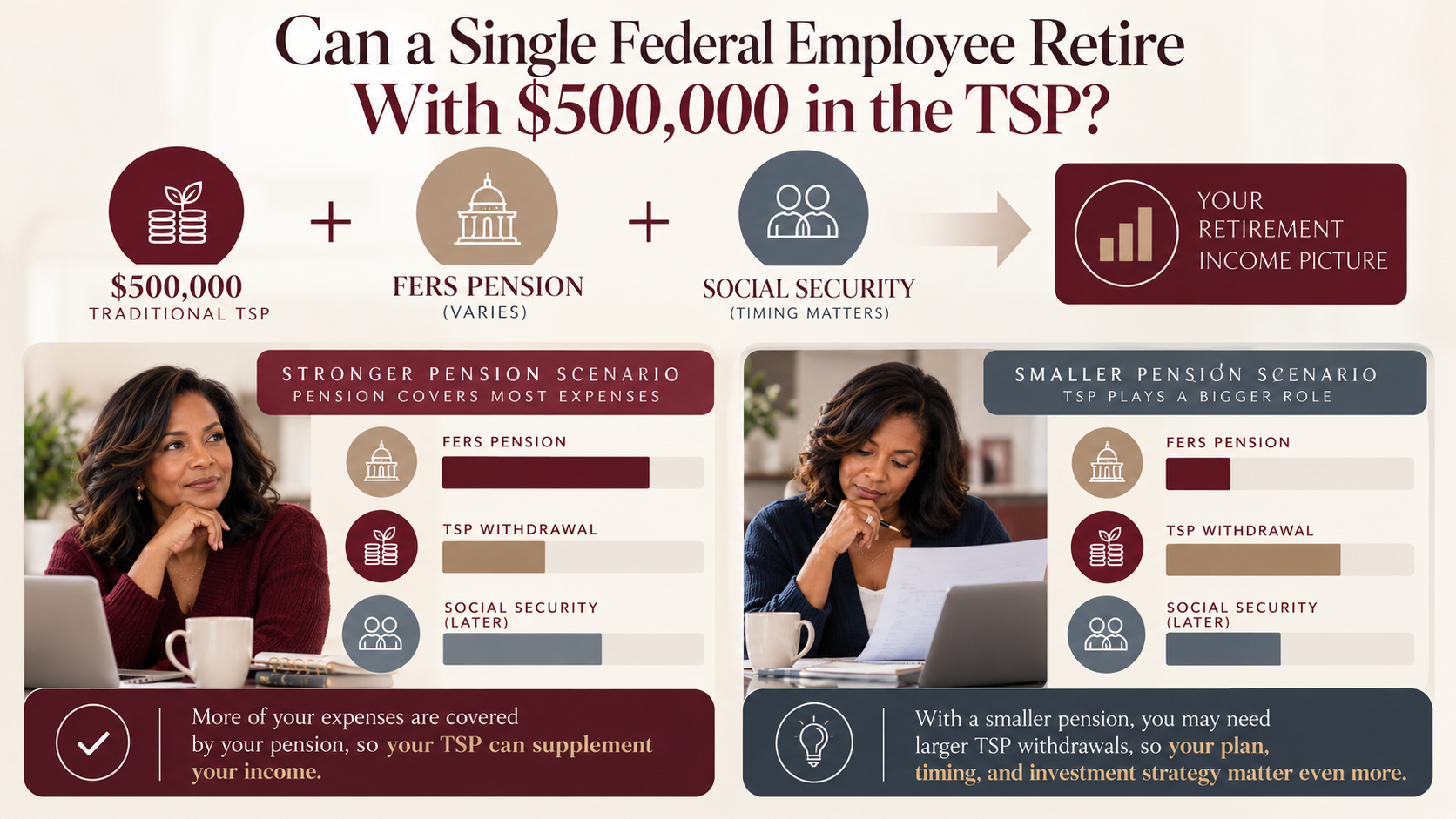
Yes, a single federal employee may be able to retire with $500,000 in the TSP, especially when a FERS pension covers much of her living expenses. Consider a retiree receiving a $36,300 annual pension who withdraws $20,000 from her Traditional TSP. In a simplified 2026 example, that could leave approximately $51,700 after federal income taxes. The bigger question is whether that income can support her lifestyle without putting too much pressure on her savings.
You've worked for years, contributed faithfully to your TSP, and watched the balance grow. Now retirement is getting closer, and you're looking at that $500,000 wondering whether it's actually enough to walk away from your federal career.
Maybe you've heard that you should have at least a million dollars before retiring. Or maybe someone told you that $500,000 is plenty because you'll also have a pension. The problem with both statements is that neither tells you what retirement will actually look like for you.
I wouldn't automatically assume that $500,000 isn't enough. But I also wouldn't assume that having a FERS pension means everything will work out.
What interests me is how much of your lifestyle your pension will cover, what you'll need from your TSP, and how those numbers may change as retirement unfolds. That's where we begin to see whether the $500,000 you've accumulated can support the life you're looking forward to.
Your FERS Pension Changes the Retirement Equation
One of the advantages of working for the federal government is that you may retire with something many Americans no longer have: a pension.
And that pension can make a tremendous difference.
Imagine two women who are both 62 and have $500,000 saved for retirement. One worked in the private sector and has no pension. The other spent 30 years in federal service and will receive a FERS pension for the rest of her life.
Those two women may have exactly the same retirement savings balance, but their financial pictures are very different.
The woman without a pension may depend on her retirement savings and Social Security to cover most of her expenses. The federal retiree, on the other hand, may already have a significant portion of her monthly income covered before taking a single dollar from her TSP.
That's why I think focusing exclusively on the size of your TSP can be misleading. Your pension may be doing more of the heavy lifting than you realize.
The real question becomes how much additional income your TSP will have to provide.
Let's Look at a Single Federal Employee With $500,000
Imagine you're 62 years old and preparing to retire after 30 years of federal service. You've accumulated $500,000 in your Traditional TSP, and your high-three average salary is approximately $110,000. You've spent decades building your retirement savings, and now you're wondering whether those numbers are enough to comfortably leave your federal career behind.
Under the regular FERS retirement formula, someone retiring at age 62 or older with at least 20 years of creditable service generally receives 1.1% of their high-three average salary for each year of service. In your case, that would mean a pension of approximately $36,300 annually, or $3,025 per month before taxes and benefit deductions. You can see how this works in the Office of Personnel Management's FERS pension calculation.
Now let's say you've figured out that $50,000 a year would allow you to live comfortably in retirement. That covers your housing, groceries, transportation, insurance, healthcare, and even some travel and experiences you've been looking forward to. With your FERS pension already providing $36,300, the difference is only $13,700 before taxes. That's a much smaller amount for your TSP to cover than the full $50,000, and it's why having a pension can make such a difference. Instead of relying on your $500,000 TSP to fund your entire retirement, you're using it to supplement income that's already coming in.
What Would Taking $20,000 a Year From Your TSP Look Like?
Let's continue with our example because this is where the numbers start becoming useful.
Suppose your FERS pension provides $36,300 annually and you withdraw another $20,000 from your Traditional TSP. Together, that's $56,300 in annual income before taxes.
For this illustration, we'll assume you're single, age 62, taking the standard deduction, and that your pension and TSP withdrawal are fully taxable. Using the 2026 federal tax brackets, your estimated federal income tax would be approximately $4,576.
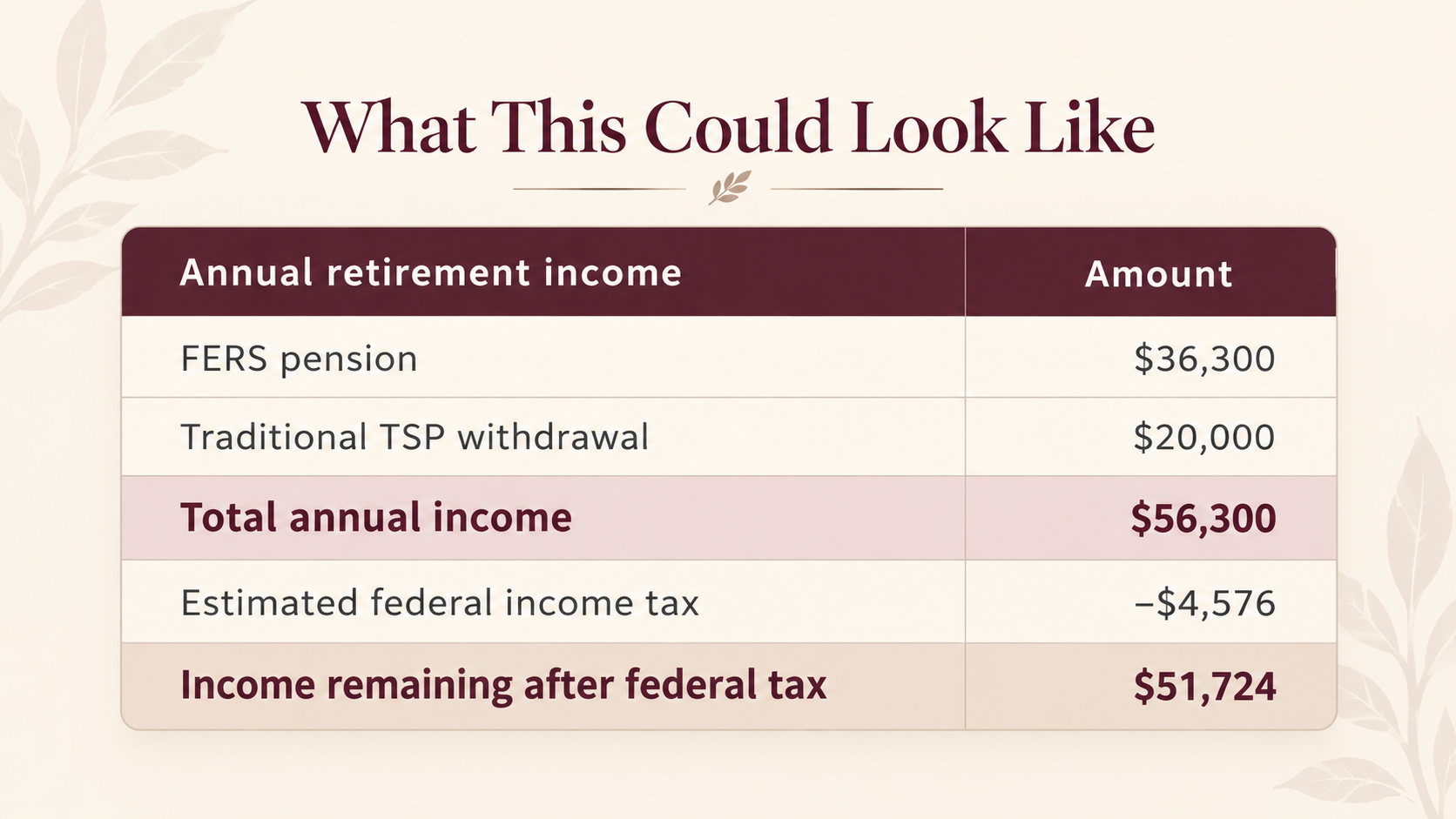
That leaves approximately $51,724 before state income taxes and any other applicable deductions.
If your retirement lifestyle is expected to cost around $50,000 annually, those numbers suggest retirement may be possible.
But notice that you're not working with a particularly large cushion. The estimated amount remaining above your spending goal is only about $1,700 for the year.
If your expenses are higher than expected or something significant happens, that cushion could disappear quickly.
And this is only a first-year illustration. It doesn't tell us how long the TSP will last or what happens if investment returns are disappointing.
This simplified example uses 2026 federal tax rules and assumes no other taxable income, credits, or special deductions. Actual FERS pensions may include a nontaxable portion. The $50,000 spending goal is assumed to include healthcare premiums and other benefits-related expenses, so those costs aren't deducted twice. State taxes are not included.
If you're curious about how taxes change when you take larger withdrawals, I've covered that separately in How Much Tax Will I Pay on Traditional TSP Withdrawals in Retirement? The important point here is that the amount you withdraw and the amount available for spending aren't necessarily the same.
Could You Continue Withdrawing $20,000 Every Year?
A $20,000 annual withdrawal from a $500,000 TSP represents 4% of your starting balance. You may have heard of the 4% rule, which is often used as a starting point for estimating how much someone might withdraw during retirement. It's a helpful guideline, but it's not a guarantee that your savings will last for the rest of your life, especially when the market doesn't cooperate.
Imagine retiring with $500,000 and watching the market decline by 20% during your first year. Your account could drop to $400,000 before you've taken a single withdrawal. If you're still taking out $20,000 annually, you're now withdrawing 5% of the remaining balance instead of 4%. And if the market takes several years to recover, those ongoing withdrawals could make it harder for your account to regain what it lost. That doesn't automatically mean you'll run out of money, but it does mean your retirement income is becoming more dependent on how quickly the market recovers.
This is why I like looking at how much income you'll want in retirement separately from where that income will come from. For some retirees, having a portion of their savings in more stable, accessible assets can provide money for living expenses without having to sell investments during a downturn. Others may consider strategies that provide predictable income while allowing another portion of their retirement savings to remain invested for growth. There's no single arrangement that works for everyone, but having different portions of your money doing different jobs can create more flexibility when the market isn't performing the way you'd hoped.
Social Security Could Change How Much You Need From Your TSP
Now let's add another piece of the retirement picture.
Suppose our federal employee plans to retire at 62 but wait until 67 to begin Social Security.
Let's say her estimated Social Security benefit at full retirement age is $2,250 per month, or $27,000 annually in today's dollars.
For people born in 1960 or later, full retirement age is 67. Although Social Security can begin as early as 62, claiming at that age can reduce the monthly benefit by as much as 30% compared with waiting until full retirement age.
The Social Security Administration explains how claiming age affects retirement benefits.
In our example, once Social Security begins, the retiree could have approximately $63,300 in combined annual FERS pension and Social Security income, expressed in today's dollars for comparison.
That's before taking anything from the TSP.
And remember, her original spending goal was $50,000.
At first glance, that sounds encouraging. Her pension and Social Security could eventually provide enough gross income to cover a large portion of her retirement lifestyle, possibly reducing the amount she needs to withdraw from her TSP.
Of course, taxes, inflation, healthcare, and other expenses could change the result. But it gives us a reason to look at retirement in different stages rather than assuming she'll withdraw the same amount from the TSP every year.
The real challenge may be the years before Social Security begins.
The First Five Years of Retirement Could Tell a Different Story
Let's go back to our 62-year-old federal employee who is planning to retire now but wait until age 67 to begin collecting Social Security. For those first five years, her FERS pension will be her primary source of dependable income, which means she'll likely rely more heavily on her TSP to cover the difference between her pension and her living expenses. Once Social Security begins, that could change considerably, allowing her to reduce how much she's withdrawing from her retirement savings.
But there's something else worth considering. Retirement expenses aren't necessarily the same from one stage of life to the next. Those first several years may be filled with travel, hobbies, and experiences she's been looking forward to throughout her career. As she gets older, some of those expenses may decrease while healthcare or other support needs increase. And if the stock market experiences a significant downturn during those early years, taking larger TSP withdrawals while her investments are declining could make it harder for the account to recover.
That's why I like paying particular attention to the first five years of retirement, especially when there's a gap between leaving federal service and beginning Social Security. A retirement plan may look quite comfortable once both the pension and Social Security are coming in, but the years leading up to that point could put more pressure on the TSP than expected. Looking at those years separately creates an opportunity to explore how income, accessible savings, and protected assets might work together so that the transition into retirement doesn't depend entirely on what the stock market happens to be doing.
What If Your FERS Pension Is Only $18,000?
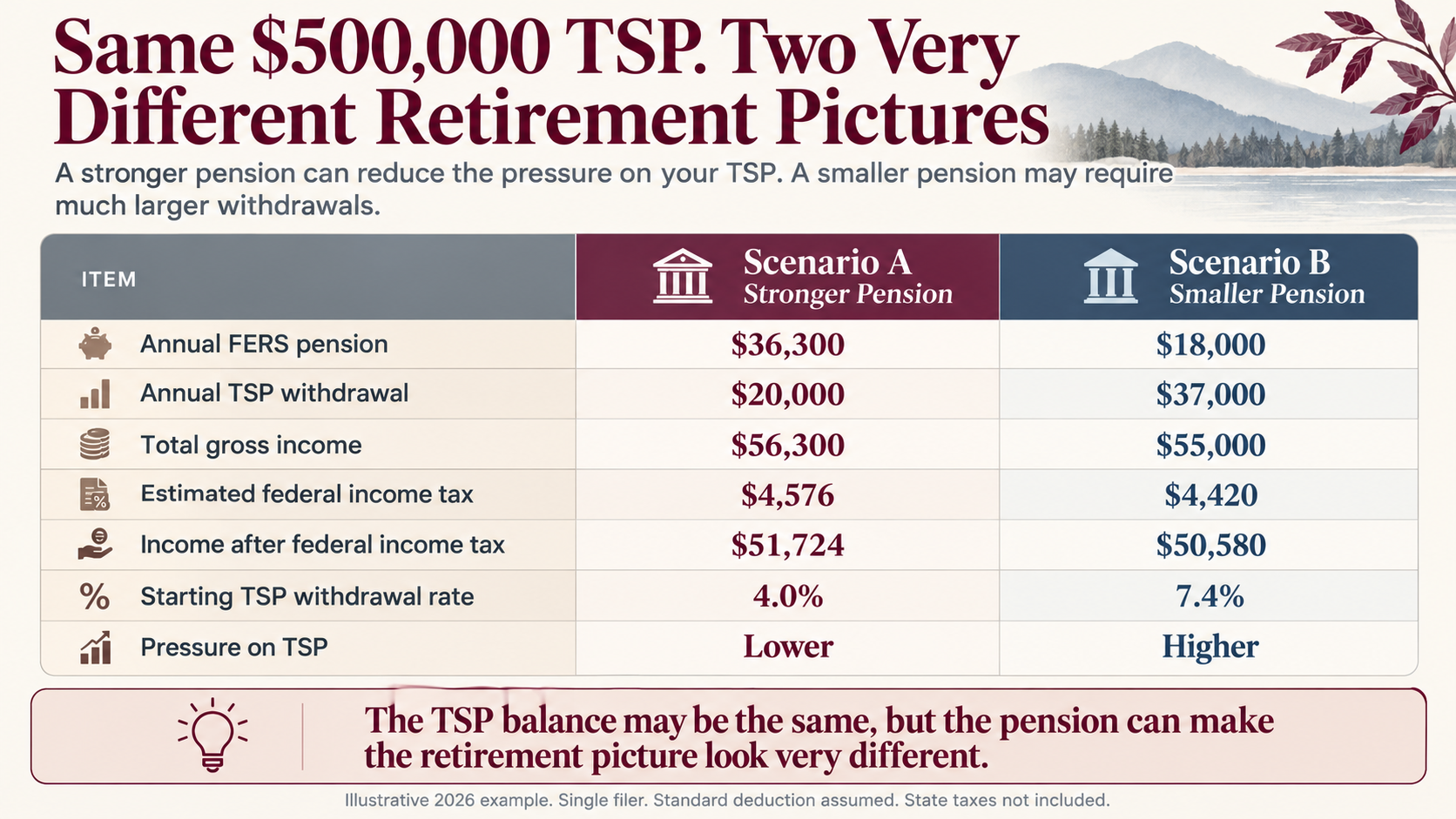
Now let's change one part of our example and see how much difference it makes. Imagine two single federal employees who are both 62 years old, have $500,000 in their Traditional TSP, and expect to spend approximately $50,000 a year in retirement. The first woman receives a FERS pension of $36,300 annually, while the second receives only $18,000. They have the same retirement savings and similar lifestyle expectations, but the amount they'll need to withdraw from their TSP is going to look quite different.
As you can see in the comparison, the woman with the larger pension could withdraw $20,000 annually from her TSP and have approximately $51,724 remaining after estimated federal income taxes. The woman with the smaller pension would need to withdraw closer to $37,000 to support a similar lifestyle, leaving approximately $50,580 after federal taxes. Both women may be able to make the numbers work in their first year of retirement, but one is withdrawing 4% of her starting TSP balance while the other is withdrawing 7.4%. That's a significant difference when you consider how many years those savings may need to last.
And that's where the conversation becomes more interesting. If both women experience the same market downturn, the woman withdrawing $37,000 annually could face considerably more pressure on her retirement savings, particularly if those withdrawals continue before Social Security begins. The larger pension provides the first woman with more flexibility because she doesn't have to depend as heavily on her investments to cover everyday expenses. This is why I wouldn't tell someone that $500,000 is enough, or isn't enough, without understanding the rest of her retirement picture. Your pension, spending expectations, Social Security timing, and how your TSP is positioned can make all the difference between simply having enough money to retire and having a strategy designed to help you stay retired.
Being Single Makes the Income Conversation Even More Important
There's another reason I pay particular attention to this question when working with single women approaching retirement. When you're building a retirement around one person's financial resources, there may not be another household paycheck, pension, or Social Security benefit to help cover the bills. That doesn't mean retirement has to be more difficult, but it does make understanding your income, expenses, and available resources especially important. After all, the financial decisions you make today may have to support you for another 25 or 30 years.
One of the wonderful things about being single in retirement is having the freedom to decide what this next chapter looks like. Maybe you want to travel more, relocate closer to family, or finally enjoy the experiences you put off while building your career. But that same independence also means unexpected expenses may fall entirely on your shoulders. Whether it's a major home repair during a market downturn, helping an aging parent, or preparing for potential long-term care needs, having money available when you need it can be just as important as having enough money invested for the future.
That's why I believe liquidity and flexibility deserve just as much attention as the size of your TSP balance. If most of your savings are exposed to market fluctuations, you may find yourself having to sell investments at an unfavorable time to cover an expense that simply couldn't wait. Having different portions of your money positioned for immediate needs, predictable income, and long-term growth can give you more options as life changes. You've worked hard to build financial independence throughout your career, and retirement is an opportunity to think about how that independence can continue without having every financial decision depend on what the stock market happens to be doing.
Healthcare Could Change Your Retirement Budget
Healthcare is one expense that can make a bigger difference in your retirement budget than you might expect. If you're planning to retire at 62, you're generally still three years away from Medicare eligibility, which means understanding how you'll maintain health insurance during those years is especially important. Fortunately, one of the advantages of federal employment is the possibility of continuing your Federal Employees Health Benefits (FEHB) coverage into retirement. Generally, you'll need to qualify for an immediate retirement annuity and have been enrolled in FEHB for the five years immediately preceding retirement, or since your first opportunity to enroll if that period was shorter. You can review the details in OPM's requirements for continuing FEHB in retirement.
Having access to FEHB can provide some peace of mind, but you'll still want to account for premiums, deductibles, copays, prescriptions, and other out-of-pocket healthcare expenses. And once you reach 65, another decision enters the picture: how Medicare will work alongside your existing federal health benefits. Depending on your circumstances, you may consider enrolling in Medicare Part B while keeping FEHB, which could change both your monthly premiums and how your medical expenses are covered. These decisions can have a meaningful impact on your retirement income, so understanding the options before you reach 65 is worthwhile. Medicare explains how retiree insurance works alongside Medicare coverage.
Now think back to our federal employee who expects to live comfortably on $50,000 a year. If that number doesn't already account for her healthcare expenses, she may discover that her retirement lifestyle costs more than she originally anticipated. Even a few hundred dollars in additional monthly expenses can mean taking more money from her TSP than planned, and those withdrawals can add up over time. That's why I like looking at healthcare as part of the overall retirement-income picture rather than treating it as a separate decision. The more accurately you understand what your retirement will actually cost, the easier it becomes to determine how much income your pension and TSP will need to provide.
Inflation Changes What $50,000 Will Buy
Another factor that can quietly change your retirement picture is inflation. Let's say you've determined that $50,000 a year will allow you to live comfortably when you retire at 62. If your living expenses increase by an average of 3% annually, maintaining that same lifestyle could cost nearly $58,000 just five years later. That's approximately $8,000 more each year, even though you haven't necessarily changed how you're living. You're still buying groceries, maintaining your home, traveling, and enjoying the activities you planned for retirement. The difference is that those same things now cost more, which means your retirement income has to stretch further.
Fortunately, Social Security and eligible FERS pensions may receive cost-of-living adjustments (COLAs) that help offset some of those increases. However, those adjustments don't always keep pace with your actual expenses, and FERS pensions have specific rules that can limit how much of an inflation increase is reflected in your benefits. That means your pension and Social Security may be increasing while your purchasing power is still declining. You can learn more about how these adjustments work through OPM's explanation of FERS cost-of-living adjustments.
This is one reason I believe growth still deserves a place in the retirement conversation, even after you've stopped working. You may want a portion of your money positioned to provide dependable income, another portion protected and accessible for unexpected expenses, and some positioned for continued growth to help address rising costs over time. The balance between those different purposes will depend on your circumstances, but the bigger picture is worth considering. After all, we're not just trying to make retirement work when you're 62. We're thinking about what your money will need to accomplish when you're 72, 82, and possibly well into your 90s.
Would an Annuity Make Sense With $500,000 in Your TSP?
An annuity could be worth considering, especially if you're concerned about protecting a portion of your retirement savings from market downturns or creating a more predictable source of income. But remember, our federal employee already has a FERS pension, and she'll eventually have Social Security as well. Depending on how much those two income sources will cover, she may be more interested in protecting some of her TSP balance while allowing it to continue growing rather than creating another immediate income stream. That's why I wouldn't automatically assume that every retiree needs the same type of annuity or that the entire $500,000 should be treated the same way.
There are different types of annuities designed to accomplish different things. Some focus on protecting principal from market losses while providing opportunities for tax-deferred growth, while others are designed to provide guaranteed retirement income. Depending on the product, certain annuities may also offer features that help address future healthcare or long-term care concerns. Meanwhile, keeping a portion of your savings in the TSP or an IRA may provide continued market growth opportunities, and maintaining accessible cash reserves can help with unexpected expenses. The goal is to understand how these different options might complement one another rather than assuming that all your retirement savings should remain in one place.
When I'm looking at someone's retirement picture, I'm interested in what each portion of their money is supposed to accomplish. If your pension and Social Security will cover most of your everyday expenses, perhaps the bigger concern is protecting what you've accumulated while maintaining opportunities for growth. If there's a gap between your guaranteed income and your living expenses, creating another dependable income source may deserve more attention.
The question isn't simply whether you should purchase an annuity. It's whether an annuity could help a portion of your $500,000 do a better job of supporting the retirement you envision.
What About Taxes on Your $500,000 TSP?
There's another important piece of the retirement puzzle that can make a big difference in how much of your money you actually get to enjoy, especially if most or all of your TSP is Traditional. When you look at your statement and see $500,000, it's easy to think of that as money available to support your retirement. But because Traditional TSP contributions generally went into the account before income taxes were paid, withdrawals are usually taxable. And once those withdrawals are combined with your FERS pension and eventually Social Security, you may find that your tax bill is larger than you anticipated. That means the amount showing on your statement and the amount you'll actually have available to spend can be two very different numbers.
This is why I believe retirement-income planning and tax planning belong in the same conversation. It's not just about how much money you withdraw from your TSP, but also when you withdraw it and how those withdrawals affect your overall taxable income. For example, the years between retiring and beginning Social Security could create opportunities to consider partial Roth conversions or adjust how you're drawing income from different accounts. You may also want to explore whether having some money in Traditional accounts, some in Roth accounts, and other assets positioned for tax-efficient income could provide greater flexibility as your retirement progresses. I've explored some of these considerations in All My TSP Money Is Traditional. What Should I Do Before I Retire?.
The point isn't that you should automatically move your entire $500,000 out of the Traditional TSP or convert everything to Roth. It's that understanding the tax consequences before you begin taking distributions can open the door to decisions you might not have considered. After spending decades building your retirement savings, it makes sense to explore how to keep more of your money working toward your retirement goals rather than allowing unnecessary taxes to quietly reduce what you have available to spend.
What This Means for You
So, can a single federal employee retire with $500,000 in the TSP? Absolutely, it's possible, especially when a FERS pension is already providing a significant portion of the income needed to cover everyday expenses. But as we've seen, having $500,000 saved doesn't automatically tell us whether retirement will be comfortable or how long those savings might last. Your pension, living expenses, Social Security benefits, and the way your retirement savings are positioned all play a role in determining what's possible.
Think back to the two women in our examples. The first receives a $36,300 annual FERS pension and supplements it with $20,000 from her TSP, leaving her with approximately $51,700 after estimated federal income taxes. The second receives a smaller $18,000 pension and needs to withdraw closer to $37,000 from her TSP to maintain a similar lifestyle. Both women have the same $500,000 retirement balance, but the second is drawing down her savings much faster. And while either scenario could work in the first year, neither tells us what happens when the market declines, expenses increase, or retirement stretches into its second or third decade.
That's why I believe it's important to look beyond your first year of retirement and consider how your income needs may change over time. The years before Social Security begins could look very different from the years afterward, and decisions about taxes, healthcare, liquidity, and protecting your savings can influence how comfortably you navigate those changes. A personalized retirement analysis can help bring those pieces together so you can see whether retirement is closer than you thought or whether a few adjustments could put you in a stronger position. The goal isn't simply to find out whether you have enough money to retire. It's to understand how your money can continue supporting you once you're no longer receiving a paycheck.
Frequently Asked Questions
-
It can be, particularly if your FERS pension covers most of your regular living expenses. A strong pension may allow you to take smaller withdrawals from your TSP, which could help preserve retirement savings over time.
But taxes, healthcare costs, Social Security timing, and investment performance can all change the outcome. The most useful comparison is between the income you expect to receive and the expenses you expect to have.
-
A $20,000 annual withdrawal would provide approximately $1,667 per month before taxes.
That's 4% of a $500,000 starting balance, but it isn't guaranteed income and doesn't mean that withdrawal amount will be sustainable indefinitely.
The appropriate amount depends on how long retirement may last, the investments in the account, the amount of other income available, and whether withdrawals will increase with inflation.
-
Generally, yes.
Under the regular FERS rules, an employee who retires at age 62 or older with at least 20 years of creditable service can qualify for an immediate, unreduced pension.
The basic annuity calculation is generally 1.1% of the high-three average salary multiplied by years of service.
Different rules can apply to certain employee categories and special retirement situations.
-
That depends on the role Social Security will play in your retirement income.
Claiming at 62 provides income sooner but reduces the monthly benefit compared with waiting until full retirement age.
Delaying Social Security may provide a larger monthly benefit later, but it could also mean relying more heavily on TSP withdrawals during the years you're waiting.
Comparing both scenarios can help clarify the tradeoff.
-
A market decline early in retirement can put additional pressure on your TSP if you're also withdrawing money to pay living expenses.
The impact depends on your account allocation, the size of your withdrawals, and how long the downturn lasts.
Some retirees maintain cash reserves or lower-volatility assets to help cover near-term expenses without selling as many investments during a decline.
-
There may be good reasons to keep some of your money in the TSP, roll a portion into an IRA, or reposition some into an annuity.
The TSP offers low-cost investment options, while an IRA may provide a broader range of investments and opportunities for growth.
An annuity may offer protection from market losses, tax-deferred growth, or predictable retirement income, depending on the product.
But this doesn't have to be an all-or-nothing decision. Different portions of your $500,000 can serve different purposes, whether that's continued growth, protection from market downturns, or dependable retirement income.
The question is which combination makes the most sense for the retirement you're envisioning.
That's exactly the kind of conversation we can have together. A complimentary Retirement Analysis gives us an opportunity to look at your TSP, pension, Social Security, and retirement goals to explore which options may work best for you.
The Goal Isn't Just to Retire. It's to Stay Retired.
You may have spent 25 or 30 years building a successful federal career, steadily contributing to your TSP, and dreaming about the day when your time would finally be your own.
Now you're getting close enough to retirement that the dream is starting to feel real.
And maybe that $500,000 balance feels reassuring one day and a little unsettling the next.
I understand why. When you're single, it's a big decision to leave a dependable paycheck behind and begin relying on the money you've spent decades accumulating.
But I wouldn't allow an arbitrary million-dollar target to decide whether retirement is possible.
The more useful approach is to understand what your pension will provide, how your TSP can supplement that income, when Social Security may enter the picture, and whether the overall strategy can support your lifestyle without placing too much pressure on your savings.
That's what turns a retirement account balance into a retirement-income strategy.
Ready to Find Out What Your Retirement Money Can Actually Do?
If you have $500,000 in your TSP and retirement is getting closer, there's value in seeing how your numbers work together rather than relying on generic retirement rules.
A Retirement Analysis can help you look at your FERS pension, TSP, Social Security, taxes, healthcare costs, and expected expenses to see where you stand today and what may be worth considering before making major decisions.
You may be closer to retirement than you think. Or the analysis may reveal a few things that could make the transition more comfortable.
Either way, clarity is a much better place to begin than uncertainty.
Explore Retirement Clarity with Lisa Y. Jones
Clarity first. Strategy second.
About Lisa Y. Jones
Lisa Y. Jones is a wealth strategist, financial educator, and #1 best-selling author of Financial Seasons. She helps federal employees and women approaching retirement understand how their TSP, retirement income, taxes, Social Security, Medicare, liquidity, long-term care, and legacy decisions work together.
Her approach begins with understanding what the money is intended to accomplish before evaluating products or repositioning retirement assets.
Primary Sources
U.S. Office of Personnel Management: FERS Pension Computation
Internal Revenue Service: Tax Guide to U.S. Civil Service Retirement Benefits
U.S. Office of Personnel Management: FEHB Retirement Eligibility
Important Disclosure
This article is for educational purposes only and does not constitute individualized tax, legal, investment, or financial advice. All financial examples are hypothetical and use simplified 2026 assumptions. Actual FERS pension benefits, TSP performance, Social Security benefits, taxes, healthcare expenses, and inflation will depend on individual circumstances. Withdrawal examples are not guarantees of lifetime income or investment performance. Annuity guarantees depend on the claims-paying ability of the issuing insurance company. Consult appropriate qualified professionals when evaluating your own retirement, tax, and financial decisions.