
Last Updated: November 9, 2026
Written by Lisa Y. Jones, Wealth Strategist and Financial Educator
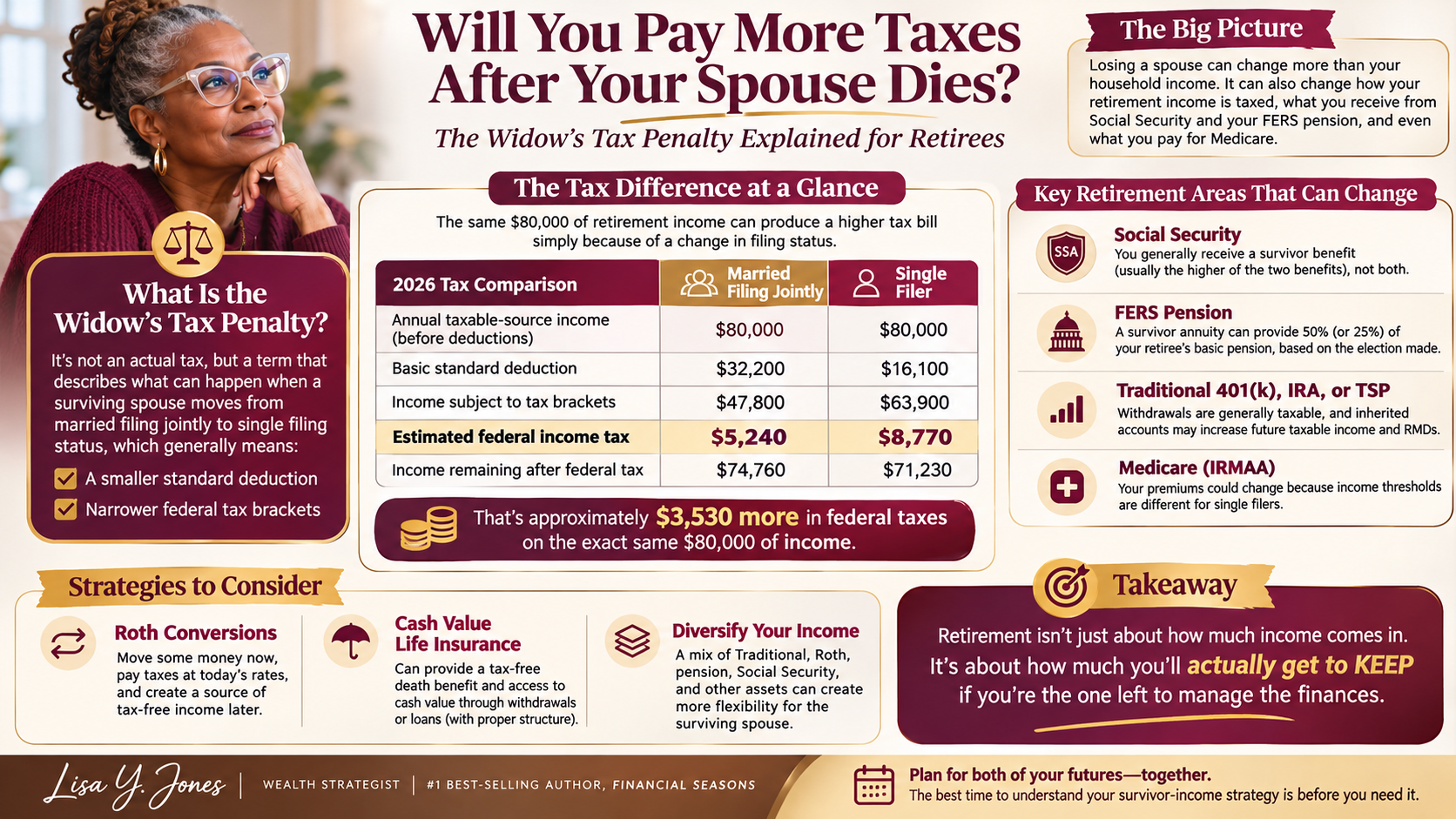
Possibly. After a spouse dies, a surviving spouse may eventually move from married filing jointly to single filing status, which generally means a smaller standard deduction and narrower federal income tax brackets. In 2026, the basic standard deduction is $32,200 for married couples filing jointly compared with $16,100 for single filers. Depending on your retirement income and other circumstances, that change could mean paying more taxes on the income you keep.
When couples are preparing for retirement, they usually spend a lot of time thinking about how much money they'll need, when to begin Social Security, and whether their savings will last. But there's another question that often doesn't come up until someone has already lost a spouse: What happens to your taxes when you're no longer married?
It's not exactly a pleasant conversation, and I understand why couples might avoid it. You've spent decades building a life together, accumulating retirement savings, and preparing to enjoy the next chapter. Thinking about how the finances might work after one of you is gone probably isn't at the top of your retirement wish list.
But here's what gets my attention. You could find yourself with retirement income that's relatively close to what you had before, yet owe more in federal income taxes because your filing status has changed. Financial professionals sometimes refer to this as the widow's tax penalty or survivor's tax penalty. It's not an official IRS tax, but it describes a very real challenge that surviving spouses can encounter.
And if a significant portion of your retirement savings is sitting in a Traditional 401(k), IRA, or Thrift Savings Plan (TSP), the impact may become even more important as you begin withdrawing that money.
I recently shared a short video about the widow's tax penalty, and the response reminded me just how many people are concerned about what happens to their retirement income after losing a spouse.
If this is something you've wondered about, take a moment to watch this brief video:
It's a quick introduction to an issue that deserves more attention, especially when much of your retirement savings is in Traditional accounts.
Let's look at how this works and what it could mean for your retirement income.
What Is the Widow's Tax Penalty?
The widow's tax penalty describes what can happen when a surviving spouse moves from the married filing jointly tax brackets to the single tax brackets. While married, couples generally benefit from a larger standard deduction and wider income tax brackets. After one spouse dies, those benefits may eventually change, even though the surviving spouse still has many of the same financial obligations.
For 2026, the IRS established a basic standard deduction of $32,200 for married couples filing jointly, compared with $16,100 for single filers. That means a married couple generally gets to subtract twice as much income through the basic standard deduction before federal income taxes are calculated. The income tax brackets are also wider for married couples, so more income may be taxed at lower rates.
You can see the official figures in the IRS's 2026 federal tax adjustments.
Now imagine you've been married for 30 years, and your retirement-income strategy was developed around those married tax brackets. If your spouse passes away, your household expenses may decrease somewhat, but your mortgage, property taxes, utilities, insurance, and many other expenses don't automatically drop by half.
Your income may change, too, but not necessarily in the same proportion as your tax benefits. That's why understanding how the tax brackets work is so important.
One clarification matters here. You can generally still file a joint return for the year your spouse dies, assuming you otherwise qualify. For the following two years, some widows and widowers with qualifying dependent children may be eligible for a special filing status that retains the joint tax rates. Others may eventually file as single or, if eligible, head of household. The IRS explains these surviving-spouse filing rules.
Let's See How the Same Retirement Income Could Produce Two Different Tax Bills
Imagine a couple receiving $80,000 annually from taxable pensions and Traditional retirement-account withdrawals. They've figured out how to live comfortably on that income, and their retirement strategy seems to be working.
Now suppose one spouse passes away, and the surviving spouse continues receiving $80,000 in taxable retirement income from her own pension and retirement-account withdrawals.
For the purpose of this illustration, we're keeping the income exactly the same so you can see what changing the filing status does by itself. We'll also assume the taxpayers are under age 65, take the basic standard deduction, have no other deductions or tax credits, and aren't receiving Social Security yet.
Here's how those numbers compare using the 2026 federal tax rules:
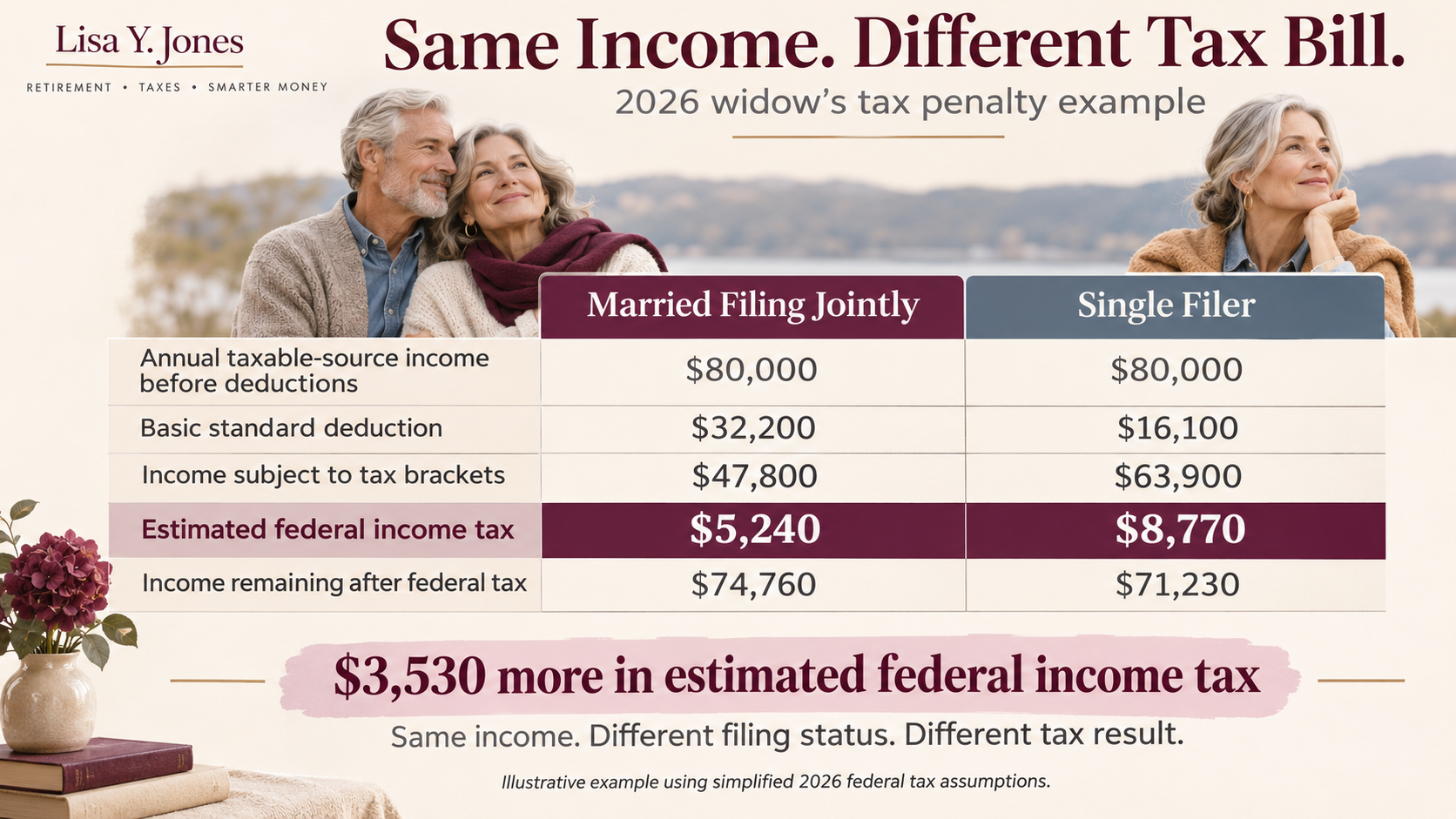
That's $3,530 more in federal income taxes on the exact same $80,000 of income.
The difference comes from the smaller standard deduction and the fact that some of the surviving spouse's income now falls into the 22% marginal tax bracket instead of remaining entirely within the 10% and 12% brackets.
That's a meaningful change when you're living on a retirement paycheck instead of earning income from a full-time career.
Of course, real-life survivor income often changes after a spouse dies, so this is a comparison of the tax rules rather than a prediction of anyone's actual before-and-after tax bill. The example also excludes the additional deductions available to eligible taxpayers age 65 or older, including the temporary enhanced senior deduction available under current law through 2028. Those provisions can affect the calculation, which is why individual tax projections matter.
The question is whether your retirement strategy would still work comfortably if the tax treatment of your income changed.
What Happens to Social Security When Your Spouse Dies?
Social Security introduces another important piece of the survivor-income conversation. Many married couples receive two Social Security payments each month, sometimes in addition to pensions, annuities, or withdrawals from retirement accounts. When one spouse dies, however, the surviving spouse generally doesn't continue collecting both Social Security retirement benefits in full.
Instead, an eligible surviving spouse may receive a survivor benefit based on the deceased spouse's record if that benefit is higher than her own. The amount and timing depend on several factors, including claiming age. The Social Security Administration explains how survivor benefits work.
Imagine you and your husband are receiving $2,800 and $2,000 per month, respectively, in Social Security benefits. Together, that's $4,800 coming into the household each month. If you pass away, your husband may qualify for a survivor benefit based on your larger benefit, but he generally won't continue receiving the combined $4,800. Depending on his eligibility and claiming circumstances, he may receive approximately the higher monthly benefit instead.
That's a substantial reduction in income, even though many household expenses may remain.
But the tax conversation doesn't end there. Social Security benefits may also be subject to federal income tax depending on your other income. The IRS uses different thresholds for determining how much of those benefits may be taxable, depending on filing status. For example, one of the thresholds is $32,000 for married couples filing jointly and $25,000 for single filers, using a calculation that includes other income and half of Social Security benefits.
You can explore those rules through the IRS's explanation of Social Security income taxation.
So a surviving spouse may experience two changes at the same time: a reduction in total Social Security income and a different federal tax calculation on the income that remains.
That's why I believe Social Security claiming decisions deserve to be evaluated as part of a couple's overall retirement-income strategy, not just as a question of which benefit to take first.
Your Traditional 401(k), IRA, or TSP Could Add Another Layer of Taxes
If you've followed my other articles about Traditional retirement accounts, you already know that the balance shown on your statement isn't necessarily the amount you'll have available to spend.
Traditional 401(k), IRA, and TSP accounts are generally funded with money that hasn't been subject to federal income tax yet. Those contributions may have reduced your taxable income while you were working, and the investment earnings accumulated on a tax-deferred basis. But when you begin taking distributions, the previously untaxed contributions and earnings are generally taxed as ordinary income.
That's an important distinction because retirement-account withdrawals don't receive special treatment simply because you're retired or because you've lost a spouse.
Imagine you've accumulated $700,000 in a Traditional TSP, while your spouse has another $400,000 in a Traditional IRA. If you inherit your spouse's retirement account, you may suddenly be responsible for managing a significantly larger pool of tax-deferred money. That inheritance doesn't necessarily create an immediate tax bill if the assets are handled through an eligible transfer or rollover, but future taxable distributions can become part of your income picture.
Depending on your age and how those accounts are handled, required minimum distributions (RMDs) may eventually increase the amount you're required to withdraw annually. A surviving spouse has special beneficiary options, so the timing isn't identical in every situation. You can review those rules in IRS Publication 590-B.
Now combine those future withdrawals with your pension and Social Security benefits. You could have several income sources creating taxable income during years when you're filing as a single taxpayer.
That's why I think the tax implications of Traditional retirement accounts deserve attention before retirement, especially when one spouse has a significantly larger balance than the other.
If your savings are concentrated in Traditional accounts, you may also find my article All My TSP Money Is Traditional. What Should I Do Before I Retire? helpful. It explores why keeping everything in one tax category may limit your options later.
What If One or Both Spouses Have a FERS Pension?
For federal employees and retirees, survivor benefits add another decision to the conversation. FERS pensions can provide valuable lifetime income, but the amount available to a surviving spouse depends on the survivor-benefit election made at retirement and the applicable eligibility rules.
For example, under the regular FERS rules, the maximum spouse survivor annuity is generally 50% of the retiree's unreduced basic pension, while an eligible partial survivor election provides 25%. These elections also affect the pension received during the retiree's lifetime.
You can review the details through OPM's explanation of FERS survivor annuity options.
Suppose a federal employee has an unreduced pension of $40,000 annually and elects the maximum FERS survivor benefit. The spouse's survivor pension would generally be based on 50% of that amount, or approximately $20,000 annually, subject to applicable adjustments and rules.
That income could be extremely important after the retiree's death, but it's still less than the original pension.
And once you add any Social Security changes and future Traditional retirement-account withdrawals, you can begin to see why the surviving spouse's finances may look different from the couple's original retirement projections.
For federal households, I believe it's worth understanding not only how much income the pension will provide during retirement but also what happens to that income when one spouse is no longer living.
Medicare Premiums Could Be Affected, Too
There's another tax-related expense that sometimes catches retirees by surprise: Medicare's Income-Related Monthly Adjustment Amount, commonly called IRMAA.
IRMAA is an additional amount some higher-income Medicare beneficiaries pay for Part B and Part D coverage. The calculation generally considers income reported on a federal tax return from two years earlier, and the income thresholds differ for single and married taxpayers.
This means a surviving spouse may face different Medicare premium calculations after a change in filing status, even if her overall income hasn't changed dramatically.
However, there's an important provision that could help. The Social Security Administration recognizes the death of a spouse as a life-changing event. If your household income has decreased, you may be able to request a reduction in your Medicare IRMAA adjustment rather than continuing to have it calculated using an older, higher-income tax return.
That request is generally made using Social Security Form SSA-44.
I bring this up because taxes and retirement expenses are often discussed separately, even though they can affect one another. The amount you're withdrawing from a Traditional IRA or TSP may influence both your federal income taxes and, in some situations, your Medicare premiums.
When we're looking at how much retirement income you'll actually get to keep, those are connected conversations.
Could Roth Conversions Help Reduce the Widow's Tax Penalty?
One strategy that may be worth evaluating before or during retirement is converting some Traditional retirement savings into Roth accounts.
A Roth conversion generally involves moving money from a tax-deferred retirement account into a Roth account and paying income taxes on the taxable amount converted. Once the applicable rules are satisfied, qualified Roth withdrawals can be tax-free.
That can be valuable because it provides a different source of retirement money that generally won't add to your taxable income when you take a qualified withdrawal.
But the timing is important.
Imagine a married couple that expects to have several years between retirement and the beginning of their required minimum distributions. Depending on their income during those years, they may have an opportunity to evaluate partial Roth conversions while filing jointly rather than waiting until one spouse is navigating a potentially different tax picture alone.
That doesn't mean converting every dollar or automatically creating a large tax bill today. A conversion may make sense in some years and not others, depending on current tax brackets, future income expectations, Medicare implications, and the amount of nonretirement money available to pay conversion taxes.
The IRS explains how Roth IRA conversions are taxed.
What interests me is the opportunity to give your retirement money more than one tax treatment. Having a combination of Traditional, Roth, and other financial resources may create flexibility when the surviving spouse is deciding where to draw income.
Where Does Cash Value Life Insurance Fit Into This Conversation?
Cash value life insurance may also deserve a place in this discussion, particularly for couples who want to address both survivor protection and tax-efficient access to money.
There are two distinct considerations here. First, life insurance provides a death benefit that can replace financial resources after a spouse passes away. Death benefits paid to beneficiaries are generally excluded from federal taxable income, subject to certain exceptions. The IRS explains the tax treatment of life insurance proceeds.
Second, certain permanent life insurance policies can accumulate cash value that may be accessed during the policyholder's lifetime. Depending on how the policy is structured and maintained, withdrawals up to basis and loans against the policy may provide access to funds without creating current taxable income. Loans accrue interest, reduce the death benefit if unpaid, and can produce tax consequences if a policy lapses or is surrendered. Modified endowment contracts follow different tax rules.
For some families, this creates an opportunity to think about protection and liquidity together rather than treating life insurance as something that only matters after death.
That doesn't mean cash value life insurance is the answer to every retirement tax challenge. The amount of coverage, the cost of maintaining the policy, the availability of cash value, and how the policy fits into the rest of the household's finances all matter.
But if we're evaluating ways to reduce reliance on fully taxable retirement withdrawals while also protecting a surviving spouse, it's a strategy worth including in the conversation.
What Can Couples Consider Before One Spouse Is Left Managing Retirement Alone?
When I think about the widow's tax penalty, I'm not just thinking about the tax return someone may eventually file. I'm thinking about the financial decisions couples make during the years when they're both still able to participate.
Consider a household where one spouse has a large Traditional retirement account, the other receives a smaller pension, and both expect Social Security to cover a meaningful portion of their expenses. Their retirement might look comfortable while both are living, but what happens if either spouse passes away first?
The answer may be different depending on who survives.
That's why I like comparing more than one retirement scenario. We can look at how income would work while both spouses are alive, how it would change if the husband survives, and how it would change if the wife survives. Those comparisons may reveal differences in pension benefits, Social Security income, tax exposure, available cash, and future retirement-account withdrawals that weren't obvious when looking at their finances as one household.
This is also where decisions about Roth conversions, annuities, life insurance, cash reserves, and retirement-account allocations can be evaluated together. Different assets can have different purposes, and those purposes may change when only one spouse remains.
A couple may discover that the retirement income they've accumulated is sufficient, but the way it's positioned could provide more flexibility. Or they may find that a particular survivor-income gap deserves attention before retirement begins.
Either way, I'd much rather see those possibilities while there are still options to evaluate than after someone is navigating the financial consequences of losing a spouse.
What This Means for You
So, will you pay more taxes after your spouse dies? It's possible, but it isn't automatic. The answer depends on how much income you continue receiving, whether you qualify for a different filing status, how your retirement accounts are structured, and which deductions and other tax provisions apply.
What makes the widow's tax penalty worth understanding is that it can affect someone who has done many of the things we associate with preparing well for retirement. She and her spouse may have accumulated substantial retirement savings, paid down their mortgage, and built dependable pension and Social Security income. Yet when the household moves from two people to one, the tax treatment of that income may become less favorable.
And that's before considering the emotional and practical challenges of losing a spouse.
I don't believe couples should approach retirement expecting the worst, but I do believe it makes sense to understand how their finances would work under different circumstances. The goal isn't simply to accumulate enough money to retire together. It's also to explore how those financial resources can continue supporting whichever spouse lives longer.
For women who have already lost a spouse, this conversation can be just as valuable. Understanding your current filing status, survivor benefits, retirement-account options, and tax exposure may reveal opportunities to make the money you have work more effectively going forward.
Retirement isn't just about how much income comes in. It's about how much is available to support the life you're living after taxes and other expenses are paid.
Frequently Asked Questions
-
Not necessarily, but you could end up paying a higher tax rate on the income you continue receiving. When you move from married filing jointly to single filing status, your standard deduction generally decreases and your tax brackets become narrower.
For 2026, the basic standard deduction is $32,200 for married couples filing jointly compared with $16,100 for single filers. If your retirement income remains relatively close to what you received as a couple, you could find yourself paying more in federal income taxes despite having one less person in the household.
For example, under the simplified 2026 assumptions used in this article, $80,000 in taxable retirement income produces an estimated $5,240 federal tax bill for a married couple filing jointly, compared with $8,770 for a single filer. That's an additional $3,530 in taxes on the same income. Actual results will depend on your age, deductions, and income sources, but the comparison illustrates why survivor-income tax planning matters.
-
Yes, for the tax year in which your spouse dies, provided you otherwise qualify to file jointly. After that year, your filing status generally changes, although you may qualify for the special qualifying surviving spouse status for up to two additional tax years if you meet the requirements, including having a qualifying dependent child and maintaining the household.
For many retirees whose children are grown, that special filing status won't apply. They may begin filing as single the following tax year, unless another filing status is available. That transition is important because your tax calculations may change even if your pension, retirement-account withdrawals, and other income remain relatively stable. The IRS explains these filing-status rules in Publication 501.
-
No. You do not continue receiving both full Social Security checks after your spouse dies. If you're eligible for benefits based on your own work record and your deceased spouse's record, Social Security generally pays an amount equal to the higher benefit, not the two amounts added together.
For example, suppose your husband receives $3,000 per month in Social Security and you receive $2,000. Together, you're collecting $5,000 monthly. If your husband dies, you may qualify for a survivor benefit of up to $3,000 per month, depending on your claiming age and other circumstances, but you won't continue receiving the combined $5,000. That's potentially a $2,000 monthly reduction in household income, or $24,000 annually, even though many of your living expenses may remain.
There can also be important decisions about when to claim survivor benefits versus your own retirement benefit. You may be able to claim one first and switch to the other later if that creates a larger benefit. The Social Security Administration explains survivor benefits and eligibility.
-
No. Simply inheriting your spouse's Traditional retirement account doesn't automatically create an immediate federal income tax bill. As a surviving spouse, you may have options to maintain inherited retirement assets in a tax-deferred arrangement or move eligible funds into your own retirement account through a properly handled rollover.
However, the money generally remains subject to income taxes when previously untaxed amounts are distributed. This can become particularly important if you already have substantial Traditional retirement savings of your own. Combining your retirement assets with inherited assets may create a larger pool of tax-deferred money that will eventually be subject to required minimum distribution rules.
The decisions you make about how to handle those inherited accounts can affect when withdrawals are required and how much taxable income you recognize in future years. You can review the IRS rules for inherited retirement accounts in Publication 590-B.
-
Yes. If you're enrolled in Medicare, becoming single can affect the income thresholds used to determine whether you pay higher Part B and Part D premiums through the Income-Related Monthly Adjustment Amount, commonly called IRMAA. Those thresholds are different for single and married taxpayers, which means a surviving spouse may face higher Medicare premiums even when household income has declined.
There's also an important opportunity to request relief. Social Security recognizes the death of a spouse as a qualifying life-changing event. If your income has decreased, you may be eligible to request a reduction in your Medicare income-related adjustment rather than having it calculated solely from an older tax return. The request is made using Social Security Form SSA-44. This is one of those details that could make a meaningful difference in how much of your retirement income you actually keep.
-
Yes, both strategies may provide opportunities to reduce future tax exposure, although they accomplish different things. A Roth conversion allows you to pay income taxes on eligible Traditional retirement money today in exchange for the potential to take qualified tax-free withdrawals later. For some couples, making partial conversions while they still benefit from married filing jointly tax brackets may create more flexibility for the surviving spouse.
Properly structured permanent cash value life insurance may offer another source of accessible money through policy withdrawals or loans, subject to applicable tax rules and policy performance. Life insurance death benefits are also generally received by beneficiaries free of federal income tax. That could provide financial resources after a spouse dies without requiring the surviving spouse to immediately withdraw additional taxable money from a Traditional retirement account.
These aren't interchangeable strategies, and neither is automatically appropriate for every household. But when much of your retirement savings is tax-deferred, exploring ways to diversify how your retirement income is taxed could be worthwhile. The IRS explains the treatment of life insurance death benefits.
-
One of the most valuable things you can do is look at what your retirement income would actually become if either spouse passed away. That means comparing your combined Social Security benefits with the survivor benefit, reviewing pension survivor elections, and understanding how much of your retirement savings will eventually be subject to income taxes.
For example, a couple might discover that their pension and Social Security income will cover their expenses comfortably while both are living, but that the surviving spouse would need to increase Traditional IRA or TSP withdrawals after losing one of those income sources. That could create additional taxable income at the same time the household moves into the single filing brackets.
This is where evaluating Roth conversions, protected income strategies, life insurance, and accessible cash reserves together may reveal opportunities that aren't obvious when each account is considered separately.
If you're approaching retirement and haven't examined what happens to your income after the first spouse dies, we can explore that together. A Complimentary Retirement Analysis can help you see how your pensions, Social Security, retirement accounts, and taxes may change so you can make decisions with a clearer understanding of your options.
The Best Time to Understand Your Survivor-Income Strategy Is Before You Need It
Losing a spouse is difficult enough without discovering that your income, retirement accounts, and taxes work differently than you expected.
Whether you're approaching retirement as a married couple or already navigating retirement on your own, there's value in understanding how your money is positioned and what you can reasonably expect to keep.
A Complimentary Retirement Analysis gives us an opportunity to look at your retirement income, pensions, Social Security, Traditional retirement accounts, and other financial resources to explore how the numbers work together. We can also consider what may change if your household goes from two retirement incomes to one.
The goal is to understand your options before making decisions that could have lasting consequences.
Explore Retirement Clarity with Lisa Y. Jones
Clarity first. Strategy second.
About Lisa Y. Jones
Lisa Y. Jones is a wealth strategist, financial educator, and #1 best-selling author of Financial Seasons. She helps federal employees and women approaching retirement understand how their TSP, retirement income, taxes, Social Security, Medicare, liquidity, long-term care, and legacy decisions work together.
Her approach begins with understanding what the money is intended to accomplish before evaluating products or repositioning retirement assets.
Primary Sources
Internal Revenue Service: 2026 Federal Tax Brackets and Standard Deductions
IRS Publication 501: Filing Status and Qualifying Surviving Spouse Rules
IRS Publication 590-B: Retirement Account Distributions and Inherited IRAs
Social Security Administration: Request to Lower Medicare IRMAA
Important Disclosure
This article is for educational purposes only and does not constitute individualized tax, legal, investment, or financial advice. All financial examples are hypothetical and use simplified 2026 assumptions. Actual FERS pension benefits, TSP performance, Social Security benefits, taxes, healthcare expenses, and inflation will depend on individual circumstances. Withdrawal examples are not guarantees of lifetime income or investment performance. Annuity guarantees depend on the claims-paying ability of the issuing insurance company. Consult appropriate qualified professionals when evaluating your own retirement, tax, and financial decisions.