
Last Updated: November 22, 2026
Written by Lisa Y. Jones, Wealth Strategist and Financial Educator
A single woman can improve the odds of making her retirement savings last 30 years by combining dependable income with flexible withdrawals, keeping money accessible for unexpected expenses, and accounting for taxes, inflation, healthcare, and market downturns. For a federal retiree, her FERS pension and Social Security may eventually cover much of her lifestyle, reducing the pressure on her TSP. The key is planning for how income needs change between age 62 and 92.
You've worked hard, built a successful career, and spent decades contributing to your retirement savings. Maybe you've accumulated $500,000, $700,000, or even more in your TSP or 401(k). You're proud of what you've accomplished, and you should be. But now that retirement is getting closer, you may be looking at those numbers and wondering whether they're really enough to support you for the rest of your life.
It's an understandable question, especially when you're single and don't have another household income to fall back on. You've been responsible for your financial decisions throughout your career, and retirement isn't going to change that. What will change is where the money comes from. Instead of receiving a paycheck every two weeks, you'll begin relying on the pension, Social Security benefits, and retirement savings you've accumulated.
And here's something worth thinking about.
If you retire at 62 and live to 92, your money will need to support you for another 30 years.
That's a long time to depend on financial decisions made at the beginning of retirement.
The encouraging news is that making your retirement savings last isn't simply about spending less or hoping the stock market performs well. It's about understanding how your different sources of income can work together, recognizing when your retirement savings may be under the most pressure, and positioning your money to accomplish different things throughout retirement.
Let's look at what that could mean for a single woman approaching retirement.
Why Planning for 30 Years Changes the Retirement Conversation
When you're 62, planning for age 92 may feel a little excessive. After all, you're probably thinking more about where you'd like to travel, what you'll do with your newfound free time, and how wonderful it will feel not to have your calendar controlled by work.
But consider how much life can change over three decades. You may spend the first several years enjoying travel and experiences you've been putting off. Later, you might decide to relocate, help family members, or make changes to your home. And as you get older, healthcare and the possibility of needing additional support could become more significant parts of your budget.
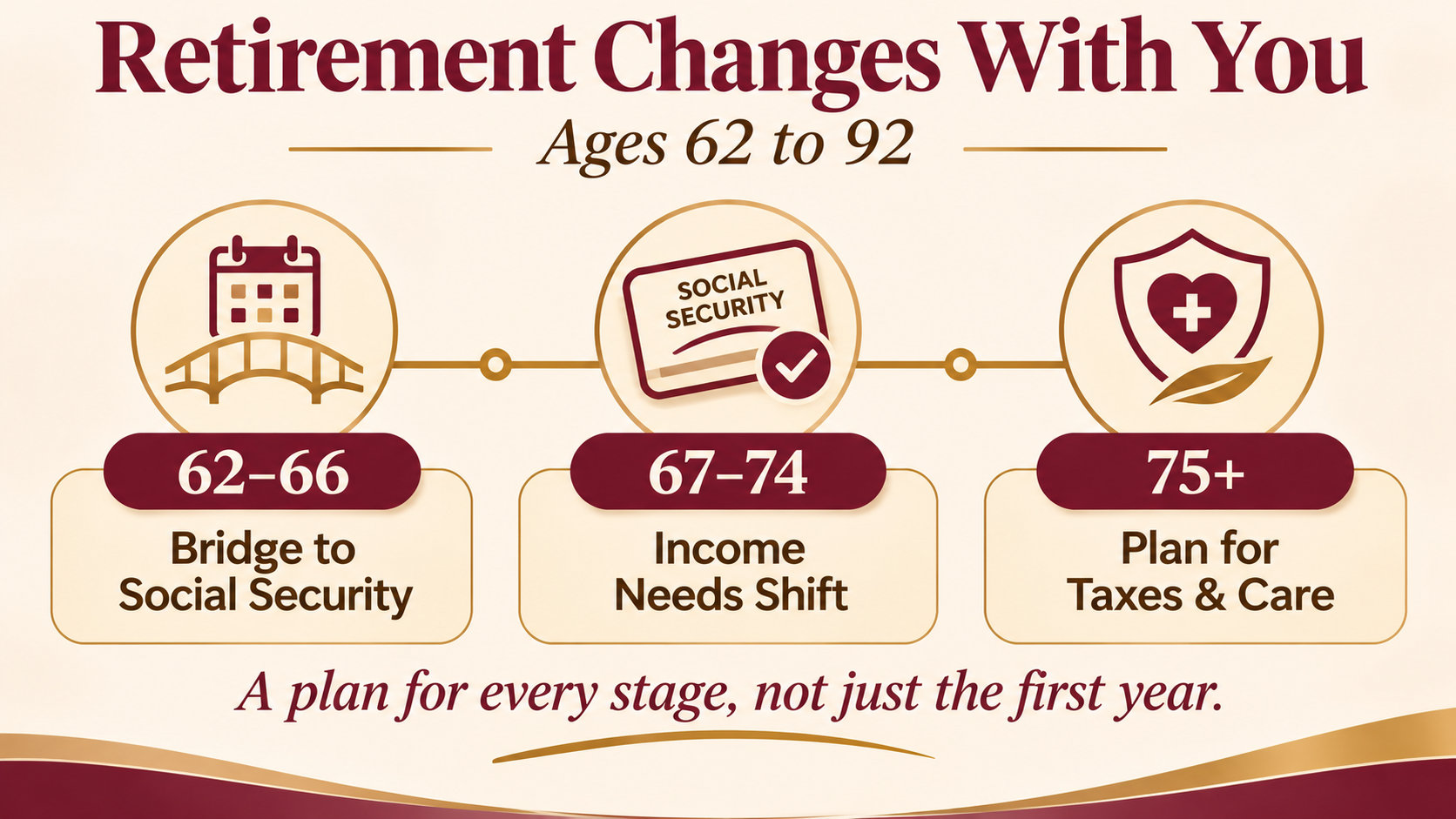
Your retirement expenses aren't necessarily going to remain the same, and neither will your income needs. That's why I don't like looking at retirement as one big 30-year calculation. I prefer looking at how life and income may change along the way. The first five years could require more money from your savings than the next ten. Later, taxes and required withdrawals may become more important. And eventually, protecting your independence and having money available for unexpected needs could matter just as much as investment growth.
I talked about this in my short video, How Long Will Your Retirement Savings Really Last?, because having $500,000, $700,000, or even a million dollars saved doesn't automatically mean that money will support another 25 or 30 years of living expenses. Inflation, taxes, healthcare, and the timing of investment returns all play a role. That's why I think retirement planning has to go beyond how much you've accumulated and consider how that money will actually support you throughout the years ahead.
When you understand those different stages, you can begin to see how a retirement strategy might be structured to support all of them rather than relying on the same approach for 30 years.
Let's Look at a Single Federal Employee With $700,000 in Her TSP
Imagine you're 62 years old and preparing to retire after 25 years of federal service. Your high-three average salary is $120,000, and you've accumulated $700,000 in your Traditional TSP. You don't have a spouse contributing to household expenses, but you've built a comfortable lifestyle and would like to maintain it when you retire.
Under the regular FERS retirement formula, someone retiring at 62 or older with at least 20 years of creditable service generally receives 1.1% of their high-three average salary for each year of service. In your case, that would produce an estimated annual pension of $33,000, or $2,750 per month before taxes and benefit deductions. You can review the calculation through the Office of Personnel Management's FERS pension information.
Now let's say you've determined that maintaining your lifestyle will cost approximately $60,000 annually, including housing, transportation, groceries, insurance, healthcare, travel, and the other things that make retirement enjoyable. That's $5,000 per month, which may be considerably less than what you were earning during your federal career, but still enough to live comfortably.
Your $33,000 pension already covers more than half of that lifestyle before taxes. The rest will need to come from your other financial resources, which initially may mean relying on your TSP. Let's say you withdraw $35,000 from your Traditional TSP during your first year of retirement. Combined with your pension, that gives you $68,000 in gross annual income.
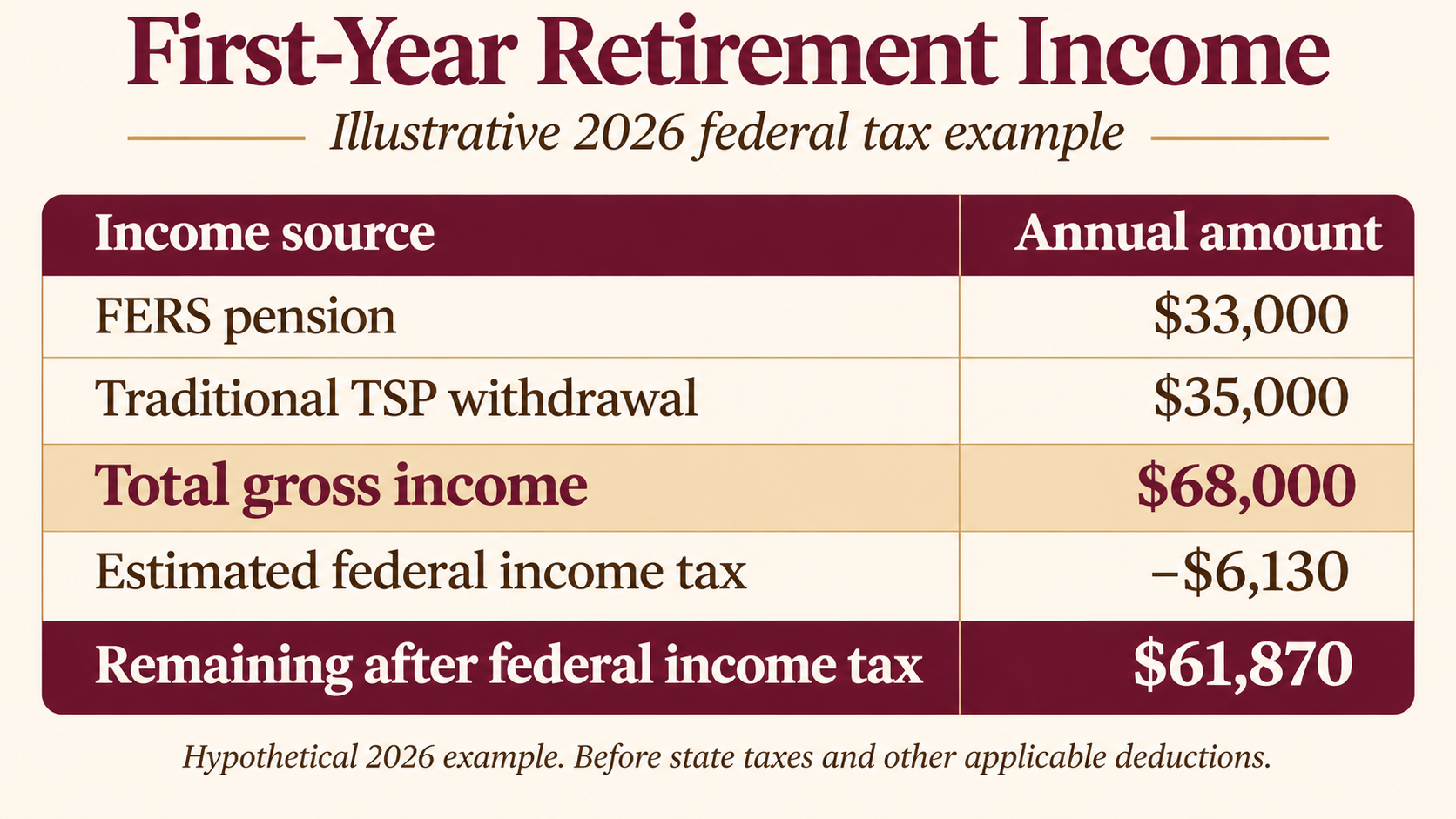
That leaves approximately $61,870 before state income taxes and any benefit-related deductions not already accounted for in the spending budget. For this example, we're assuming the pension and Traditional TSP withdrawal are fully taxable, you're single and age 62, and you're taking the basic standard deduction without additional credits.
At first glance, the numbers look promising. Your retirement income could support a $60,000 lifestyle under these assumptions, although the cushion is relatively small once other taxes and expenses are considered. But there's something else worth noticing. That $35,000 TSP withdrawal represents 5% of your starting $700,000 balance. Whether that amount remains sustainable will depend on investment performance, how your spending changes, and what happens when additional income sources become available.
This is where I would begin looking beyond your first year of retirement.
The First Five Years Could Put the Most Pressure on Your TSP
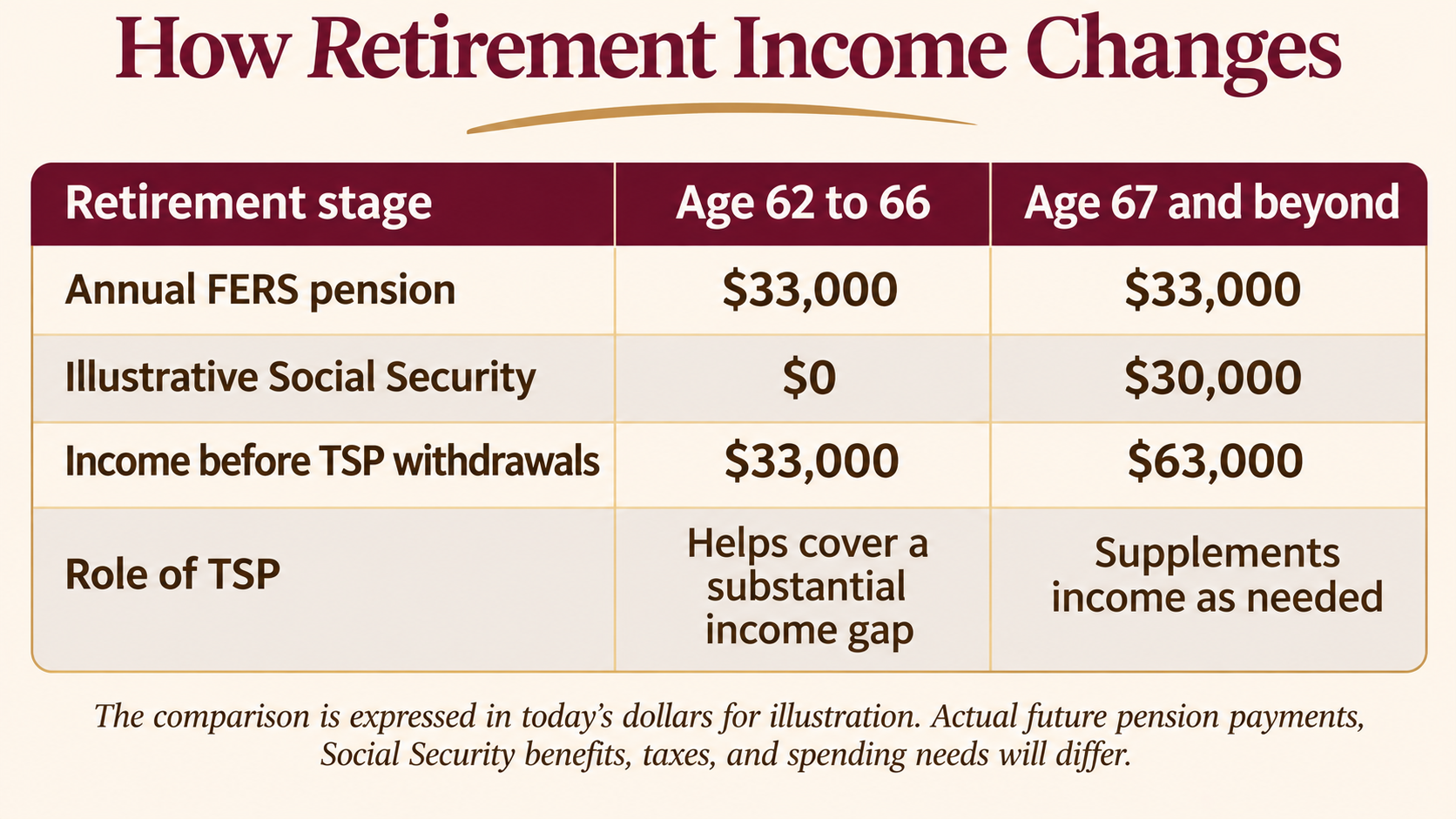
Let's assume you're retiring at 62 but planning to wait until 67 to begin collecting Social Security. That gives you five years when your FERS pension will be your primary source of dependable retirement income and your TSP will be helping cover the difference between that pension and your lifestyle.
If you withdraw $35,000 annually from your TSP during those years, you'll have taken $175,000 in distributions over five years. That doesn't mean your account will automatically decrease by $175,000, because the remaining investments may continue earning returns, but it gives you an idea of how much money you're asking the account to provide before Social Security begins.
Now imagine that your estimated Social Security benefit at 67 is $2,500 per month, or $30,000 annually in today's dollars. Once those payments begin, your combined FERS pension and Social Security could represent approximately $63,000 in annual gross income, before considering future cost-of-living adjustments. You may still need some TSP withdrawals for taxes and expenses, but your reliance on that account could decrease substantially.
Here's how those stages compare.
For someone born in 1960 or later, Social Security full retirement age is 67. Benefits may begin as early as 62 at a reduced amount or be delayed beyond full retirement age for a larger monthly benefit, up to age 70. You can compare your own projected benefits using the Social Security Administration's retirement planning tools.
What's interesting about this example is that the challenge may not be whether $700,000 can provide the same amount of income for 30 years. It may be whether your retirement savings can comfortably support the larger withdrawals during the years before Social Security begins, without sacrificing the financial flexibility you'll want later.
And that brings us to something that concerns me about relying too heavily on market investments for retirement income.
What Happens if the Market Drops During Those First Five Years?
Imagine you've retired with your $700,000 TSP and are enjoying the freedom you've worked so hard to achieve. Then the market experiences a significant downturn during your first year.
If the investments in your TSP declined by 20%, your account could fall from $700,000 to $560,000 before withdrawals. If you're still taking out $35,000 annually, that withdrawal now represents 6.25% of the remaining balance instead of the original 5%.
The problem isn't simply that your investment balance has declined. It's that you're withdrawing money while the account is trying to recover. Those distributions reduce the amount of money that remains invested, which can make the recovery more difficult.
This is often called sequence-of-returns risk, and it's particularly important during the early years of retirement. Two people can earn similar average investment returns over their retirement years but experience different results depending on when the good and bad market years occur and how much they're withdrawing during those periods.
I addressed this in my video, TSP Retirement Shock: Why Your TSP Can Shrink Fast in the First 5 Years. It's one thing to watch your account decline while you're still working and contributing to it. It's quite another to watch that same decline when you're retired and withdrawing money every month to support your lifestyle. The timing of those losses matters, which is why I believe protecting your retirement income deserves attention before you begin depending on your savings.
When you're still working, a market downturn may be an opportunity to continue buying investments while prices are lower. But once you're retired, the situation changes because you may be taking money out rather than putting money in.
For someone who is single and depending on those savings to help pay her bills, having an alternative source of money during a market downturn could make a meaningful difference.
Does the 4% Rule Work for a 30-Year Retirement?
You may have heard of the 4% rule, a retirement withdrawal guideline discussed by Investopedia. The idea is that you withdraw 4% of your investment portfolio during your first year of retirement and then adjust that initial dollar amount for inflation in subsequent years. The approach grew out of research examining whether investment savings could support approximately 30 years of retirement.
With $700,000 in her TSP, our federal employee could withdraw $28,000 during her first year using that guideline. That's $7,000 less than the $35,000 she expects to need. Does that mean she can't afford to retire? Not necessarily, and this is where I think relying too heavily on a general rule can cause someone to overlook important parts of her financial picture.
The 4% rule is a guideline based on particular assumptions about investment allocations, inflation, returns, and retirement length. It's not a guarantee that money will last 30 years, and it doesn't account for every retiree's circumstances.
Our federal employee has something important that changes the conversation: a FERS pension, followed by Social Security several years later. Because those sources of income could reduce her need for TSP withdrawals over time, a fixed withdrawal strategy may not accurately reflect how she'll use her savings.
I would be much more interested in seeing what happens if she withdraws more during the first five years, less after Social Security begins, and then makes adjustments as healthcare, inflation, and other expenses change. That approach allows us to evaluate retirement as it may actually unfold rather than expecting one withdrawal percentage to answer every question.
Give Different Portions of Your Retirement Money Different Jobs
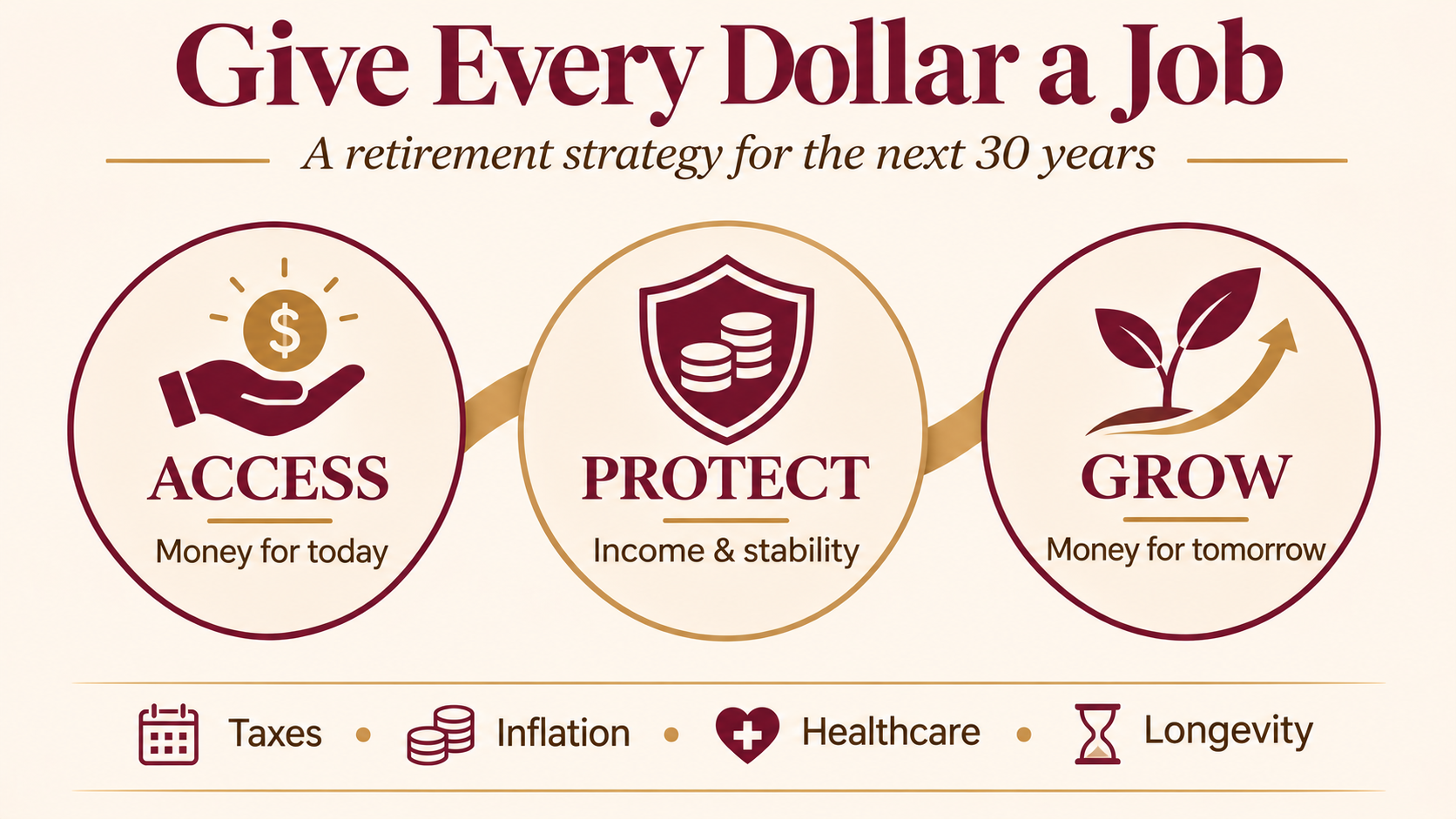
One of the concepts I often discuss with clients is that not every dollar of retirement savings has to accomplish the same thing.
Think about the money you'll need to pay bills next month compared with the money you may not need for another 15 years. They're both important, but they have different purposes. Money needed for immediate expenses may benefit from being stable and readily accessible, while money intended for much later in retirement may have more time to pursue growth.
For our single federal employee, I would want to explore how her savings could support three different needs.
Money for everyday expenses and unexpected events. This could include cash reserves, savings, or other readily accessible resources to supplement her pension and cover expenses that can't wait. Having money available outside of market-dependent investments could reduce the pressure to sell investments during a downturn.
Money positioned for protection or predictable income. Depending on her circumstances, a portion of retirement savings might be used to create additional income or protect principal from certain market losses. That could include an appropriately selected annuity designed around the specific role the money needs to play.
Money positioned for continued growth. Retirement doesn't eliminate the need for growth, particularly when savings may need to last several decades. Keeping a portion invested for longer-term opportunities may help address inflation and expenses that increase over time, while recognizing that market investments can fluctuate in value.
I've shared before that having a million dollars invested doesn't necessarily mean you have money readily available when life happens. In Market Down? What If You Need Cash NOW?, I talk about why liquidity matters just as much as the amount you've accumulated. Imagine needing $20,000 for an unexpected expense while your investments are already down. Having accessible money set aside for situations like that may give you more choices instead of forcing you to withdraw from investments at an unfavorable time.
These aren't necessarily three separate accounts, and there's no universal percentage that belongs in each category. The idea is to consider what different portions of the money are supposed to accomplish, and whether the current arrangement supports those purposes.
For a woman who has spent decades building a successful career, this can be a different way of looking at money. Instead of focusing only on how much you've accumulated, you're thinking about how that accumulation can support the life you want to live.
Could an Annuity Help Your Retirement Savings Last Longer?
An annuity may be worth considering if you want to reduce the amount of money you must withdraw from market-dependent investments or protect a portion of your savings while continuing to participate in potential growth.
There are different types of annuities designed for different purposes. Some fixed indexed annuities can protect principal from negative index-crediting periods while offering opportunities for tax-deferred interest credits, subject to the contract terms. Other annuities are structured to provide guaranteed income, which can help cover retirement expenses regardless of how long you live.
Let's return to our federal employee with the $33,000 pension. Suppose her pension and eventual Social Security payments will cover most of her essential expenses, but she's concerned about how market downturns could affect her remaining retirement savings. In that situation, she may be more interested in protecting a portion of her accumulated money while leaving another portion invested for growth.
Another woman might have a smaller pension and a much larger gap between her dependable income and monthly expenses. For her, an annuity designed to provide additional lifetime income may deserve more consideration.
That's why I don't begin with the assumption that everyone needs the same annuity. The more useful question is whether an annuity can help a specific portion of your money accomplish something that's missing from your current retirement strategy.
Annuities have different contract provisions, including access and withdrawal terms, and guarantees are backed by the financial strength and claims-paying ability of the issuing insurance company. Those details belong in a complete comparison of the available options.
Inflation Can Quietly Change What Your Retirement Costs
Let's say you've built a retirement budget of $60,000 a year and feel comfortable that your pension and savings can support it. That's a good starting point, but we also have to consider what happens to the cost of that lifestyle over the next 30 years.
If your expenses increase by an average of 3% annually, the same $60,000 lifestyle could cost approximately $108,000 a year after 20 years and nearly $146,000 after 30 years. That doesn't mean you'll suddenly be living extravagantly at 92. It means the groceries, utilities, housing, transportation, and other things you're already paying for could cost considerably more.
Fortunately, Social Security benefits and eligible FERS pensions may receive cost-of-living adjustments that help offset some of those increases. But the adjustments aren't always the same as the increases you're experiencing in your personal expenses. FERS pensions also have specific rules that can limit the adjustment in years when inflation rises above certain levels. You can learn more through OPM's explanation of FERS cost-of-living adjustments.
This is why I believe continued growth can still have a place in retirement, even when you've accumulated enough to stop working. You may want some financial resources focused on the income you need today while others remain positioned to help address expenses many years from now.
The goal isn't simply to make your money last on paper. It's to consider whether it can maintain enough purchasing power to support your lifestyle as the years go by.
Taxes Could Determine How Much of Your Retirement Income You Actually Keep
There's another factor that becomes particularly important for high-earning women who accumulated most of their retirement savings in Traditional accounts.
When you contributed to your Traditional TSP or 401(k) during your career, those contributions generally reduced the income subject to federal income tax. The investments then accumulated earnings on a tax-deferred basis. That was helpful while you were working, but it also means federal income taxes on those pretax contributions and earnings have been postponed rather than eliminated.
Now imagine entering retirement with $700,000 in a Traditional TSP. If you're withdrawing money to supplement your pension, those withdrawals generally become part of your taxable income. And once Social Security begins, the combination of your pension, Traditional withdrawals, and Social Security may affect how much of your benefits are subject to income tax.
And this is where retirement income can get a little tricky. You may have enough money coming in to support your lifestyle, but the amount you're actually able to spend could be considerably less after federal income taxes. For example, withdrawing $35,000 from your Traditional TSP doesn't mean you'll have another $35,000 available to spend. That withdrawal becomes part of your overall tax picture alongside your pension and eventually Social Security. I walk through how those income sources interact in How Much Tax Will I Pay on Traditional TSP Withdrawals?, including why the same withdrawal can produce different tax results depending on what other income you're receiving.
For 2026, the basic federal standard deduction for a single filer is $16,100. Eligible taxpayers age 65 or older may qualify for additional deductions, but those provisions don't eliminate the importance of understanding how retirement-account withdrawals affect taxable income. You can review the applicable rules through the IRS's 2026 tax guidance.
One opportunity some retirees explore is converting a portion of their Traditional retirement savings to Roth accounts during years when their taxable income may be lower. A Roth conversion generally creates taxable income in the year of conversion, but qualified Roth withdrawals later can be tax-free. Since January 28, 2026, the TSP has also allowed eligible participants to make Roth in-plan conversions, which creates another option to evaluate without necessarily moving the money out of the TSP.
If you haven't explored how your Traditional retirement savings may affect your future taxes, I've discussed some of those considerations in All My TSP Money Is Traditional. What Should I Do Before I Retire?.
The point isn't that every dollar should be converted or repositioned. It's that having retirement assets with different tax treatments may provide more flexibility when you're deciding where to take income over the next 30 years.
Required Minimum Distributions May Change Your Income Strategy Later
Our hypothetical retiree is 62 in 2026, which means she was born after 1960. Under current law, her applicable required minimum distribution age is generally 75.
That gives her approximately 13 years between retiring and reaching the age when required distributions begin from her Traditional retirement accounts.
Depending on how her investments perform and how much money she withdraws during those years, she could still have a substantial Traditional TSP or IRA balance at 75. At that point, the IRS generally requires her to withdraw at least a minimum amount each year, based on her account balance and the applicable life expectancy factor.
Those required withdrawals are generally taxable and may influence her tax bracket and Medicare premiums, even if she doesn't need all the money for living expenses. You can review the IRS rules for required minimum distributions.
This is another reason I don't think retirement planning should end once you've calculated your pension and first-year withdrawals. Decisions you make at 62 can influence what your financial picture looks like at 75 and beyond.
Healthcare and Long-Term Care Deserve Their Own Place in the Plan
When I think about a 30-year retirement, healthcare is one of the areas I wouldn't want to underestimate, particularly for a single woman who may eventually be responsible for managing those decisions without a spouse.
If you're retiring from federal service at 62, you may be eligible to continue your Federal Employees Health Benefits coverage into retirement. Generally, that requires eligibility for an immediate annuity and FEHB coverage during the five years immediately preceding retirement, or since your first opportunity to enroll if that period was shorter. You can review OPM's FEHB retirement eligibility rules.
At 65, Medicare adds another set of decisions. Depending on your circumstances, you may consider Medicare Part B alongside FEHB, and your income could affect your Medicare premiums. You'll also want to account for prescriptions, deductibles, dental and vision expenses, and services that may not be fully covered by your existing benefits. Medicare provides information about coverage and costs.
But I'm also thinking about what happens much later in retirement. What if you're 82 and need help with daily activities? What if you'd prefer to receive care at home rather than move into a facility? What if you need to make your home more accessible or hire someone to provide assistance?
Those possibilities don't mean you'll necessarily need long-term care. They do suggest that having financial resources available for different circumstances is worth considering.
Some insurance-based strategies, including certain life insurance policies and annuities with applicable care-related benefits, may provide resources that can be used toward qualifying long-term care needs. Other approaches rely on dedicated savings or separate coverage.
For a single woman, I believe this conversation is about more than paying medical bills. It's about preserving choices and independence as you get older.
Retirement Planning Is Also About Maintaining Your Independence
One of the things I appreciate about working with single women is the independence they've developed throughout their careers. Many have managed demanding jobs, supported family members, purchased homes, invested consistently, and made important financial decisions without depending on another household income.
But retirement introduces a different kind of financial responsibility.
When you're working, an unexpected expense may be frustrating, but you still have a paycheck coming in. In retirement, that same expense may mean withdrawing additional money from your investments, spending part of your cash reserves, or adjusting your income strategy.
Imagine needing a $20,000 home repair during a year when the market is down. Or deciding to help an aging parent, support an adult child through a difficult season, or make a move that brings you closer to family. Perhaps you simply want the freedom to take a trip without wondering whether it will disrupt your retirement finances.
Having money available when those situations arise can be just as important as having money invested for long-term growth.
I also think it's worth considering who would help manage your finances if you were temporarily or permanently unable to make decisions yourself. Beneficiary designations, powers of attorney, healthcare directives, and access to important financial information deserve attention, particularly when there isn't a spouse who would automatically be involved.
You've spent decades building financial independence. A thoughtful retirement strategy can help you consider how to maintain that independence throughout the years ahead.
How Would I Evaluate Whether $700,000 Could Last 30 Years?
Rather than beginning with a particular investment return or withdrawal percentage, I'd begin by understanding how your retirement income and expenses fit together.
For our 62-year-old federal employee, the first question is how much of her lifestyle will be covered by the $33,000 FERS pension. From there, I'd want to understand what happens during the five years before Social Security begins and how much money she'll need from her TSP during that period.
Then I'd look at how the picture changes once Social Security begins. If her pension and Social Security provide approximately $63,000 annually in today's dollars, will she still need substantial TSP withdrawals, or could more of that money remain invested for future expenses?
I'd also want to see what happens if the market experiences a significant downturn early in retirement. Does she have accessible money to cover expenses, or would she have to continue taking withdrawals from investments that have already declined? And if she lives into her 90s, how much of her income is dependable, how much is exposed to market fluctuations, and what resources are available for rising healthcare costs?
Finally, I'd examine how taxes fit into the strategy. Having $700,000 in a Traditional TSP isn't the same as having $700,000 available to spend after taxes, and the timing of withdrawals, Roth conversions, and eventual required minimum distributions could influence her long-term income.
None of these questions can tell us exactly what the stock market will do over the next 30 years. But evaluating different scenarios can help reveal where a retirement strategy is strong and where adjustments may provide more flexibility.
That's a much more useful conversation than simply asking whether $700,000 is enough.
What This Means for You
So, how can a single woman make her retirement savings last 30 years? I believe the answer begins with understanding that your retirement savings don't have to carry the entire financial responsibility on their own.
If you're a federal employee, your FERS pension may already cover a meaningful portion of your living expenses. Social Security can eventually provide another income source, potentially reducing the amount you'll need from your TSP. The challenge is making sure the savings you've accumulated can support you during the years when your income needs are greater, while still being available for the years that follow.
Think about the woman in our example. She has $700,000 in her Traditional TSP and a $33,000 FERS pension. During her first five years of retirement, she may need to withdraw approximately $35,000 annually to help maintain her lifestyle. Once Social Security begins, however, the amount she needs from the TSP could decrease considerably.
That creates an opportunity to think about how different portions of her money might serve different purposes. Some may provide accessible cash for everyday expenses and unexpected needs. Some may be positioned for protection or predictable income, while another portion remains invested for longer-term growth.
And because retirement may last 30 years or more, decisions about taxes, inflation, healthcare, and long-term care belong in that same conversation.
If you've been wondering whether your retirement savings are enough, remember that the balance on your statement is only part of the picture. In my article Can a Single Federal Employee Retire With $500,000 in the TSP?, we explored how two women with identical TSP balances could have very different retirement outcomes because of their pensions and income needs.
The same principle applies here. Two women with $700,000 in retirement savings may have completely different financial futures depending on how much they withdraw, when they begin Social Security, and how their money is positioned.
The goal isn't simply to make your savings last 30 years. It's to give yourself the financial flexibility to enjoy those years without spending retirement constantly worrying about what might happen to your money.
Frequently Asked Questions
-
Paying off your mortgage before retirement can sound like the perfect way to reduce your monthly expenses, especially when you're single and preparing to live on a fixed income. But what if eliminating that payment actually leaves you in a more vulnerable financial position? Imagine having $700,000 in your Traditional TSP and deciding to withdraw $150,000 to pay off the remaining mortgage. You may eliminate your monthly payment, but that withdrawal could create a substantial federal income tax bill and leave you with significantly less money available for the next 30 years. Depending on your age, income, and timing, large taxable withdrawals could also affect your Medicare premiums.
There's also something worth considering about having a paid-off home. While eliminating a mortgage payment can improve monthly cash flow, the equity in your house isn't the same as having money readily available when you need it. If an unexpected expense arises, accessing that equity may require selling your home or borrowing against it. That's why I believe the decision deserves more attention than simply asking whether being debt-free feels better. Would you rather enter retirement without a mortgage, or with a mortgage and more accessible retirement savings? Depending on your interest rate, income, tax situation, and available reserves, the answer may surprise you.
-
This is a conversation I think more women should have before retirement, especially those who have spent years being the financially responsible person everyone knows they can count on. Maybe you're helping an adult child who hasn't quite found their financial footing, contributing toward a grandchild's education, or assisting an aging parent. Those are meaningful things to do, but they can also quietly become permanent expenses that were never included in your retirement calculations.
Consider what happens if you're providing $1,000 a month to help family members. That's $12,000 annually, or $120,000 over ten years, before considering taxes or investment growth you may have given up. If that money is coming from a Traditional retirement account, the amount you need to withdraw could be even greater. There's a difference between having the resources to help someone occasionally and having your retirement savings become their ongoing source of income. Generosity and financial independence don't have to compete, but it's worth understanding how much assistance your retirement strategy can comfortably support without putting your own future at risk.
-
That's a question worth considering because a 30-year retirement plan is built around an assumed timeline, not an expiration date. If you retire at 62 and plan through age 92, what happens if you're still enjoying life five or even ten years later? You may have spent 30 years managing withdrawals carefully, but your housing, groceries, healthcare, and everyday expenses don't stop simply because you've reached the age used in your original projections.
This is where dependable lifetime income can make a meaningful difference. A FERS pension and Social Security can continue providing eligible payments for life, and certain annuities can provide additional guaranteed lifetime income under their contract terms. Having income sources that don't depend entirely on how much remains in an investment account may help reduce the pressure on your savings as you get older. I'd want to see how a retirement strategy performs not only through age 92, but also at 95 and 100. Living longer should be something to celebrate, not a financial emergency you didn't prepare for.
-
Not for most ongoing personal care, and this is one of the more expensive misunderstandings someone can carry into retirement. Medicare may cover certain medically necessary skilled nursing or home health services when eligibility requirements are met, but it generally doesn't pay for long-term custodial care. That includes the kind of ongoing help someone may need with bathing, dressing, eating, or other everyday activities, whether that assistance is provided at home or in a care facility. You can review those limitations in Medicare's explanation of long-term care coverage.
Now consider what that means for a single woman who wants to remain in her home for as long as possible. If you eventually need someone to assist you several days a week, where will that money come from? Will you be withdrawing additional funds from your TSP, using savings you originally intended for living expenses, or relying on family members who may have responsibilities of their own? Some women explore dedicated long-term care coverage, while others consider insurance strategies with qualifying care-related benefits or financial assets specifically positioned for future care.
The question isn't only whether you can afford to live independently in retirement. It's whether you'll have the financial resources to preserve your choices if living independently becomes more difficult.
-
Yes. Certain annuities with lifetime income guarantees can continue making payments even after the contract's account value has been depleted through covered income withdrawals, provided the applicable contract conditions have been satisfied. That's an important distinction because an annuity's account value and the amount used to calculate guaranteed lifetime income are not necessarily the same thing. The available guarantees depend on the particular product, its income provisions, and the financial strength and claims-paying ability of the issuing insurance company.
Think about what that could mean for someone planning a retirement that may last 30 years or longer. With an investment account, the income you can withdraw depends in part on the money remaining in the account. A properly structured lifetime-income annuity can provide a different arrangement, where eligible income payments continue for the period guaranteed under the contract, including for life when that option applies. That doesn't mean every annuity works this way or that all your retirement savings belong in one.
But if one of your greatest concerns is outliving your money, wouldn't it be worth exploring whether a portion of your savings could provide income for as long as you live?
-
This may be one of the most important questions for a single woman to consider, and it has very little to do with how well her investments perform. Imagine being hospitalized after an unexpected medical event or developing a condition that makes it difficult to manage your finances. Your FERS pension and Social Security may continue arriving, and your retirement accounts may still have substantial balances, but someone may need the legal authority to pay bills, manage accounts, communicate with financial institutions, and make decisions on your behalf.
Having beneficiaries listed on your accounts doesn't automatically solve that problem because beneficiary designations generally address what happens after death, not who has authority to manage your finances while you're alive. A properly prepared durable financial power of attorney, healthcare directives, and a plan for accessing important financial information can help establish who will act for you if you're unable to do so. Without appropriate arrangements, loved ones may face delays or need court involvement to obtain decision-making authority, depending on state law and the circumstances.
For a woman who has worked hard to build financial independence, this is about protecting more than her account balances. It's about having a say in who handles her affairs and how her resources are used if she needs help.
You've spent decades making decisions about your money. It makes sense to have a plan for who can carry out your wishes if there's ever a time when you can't.
The Goal Isn't Just to Retire. It's to Enjoy the Years You've Worked So Hard For.
You've spent decades showing up for work, meeting responsibilities, contributing to your retirement accounts, and making decisions that helped you build financial independence.
Now you're approaching a stage of life when your time can belong to you in a completely different way.
Maybe you're looking forward to traveling, volunteering, spending more time with family, or simply enjoying the freedom to decide what each day looks like. Whatever your vision, your financial strategy should support that life rather than make you feel as though every spending decision puts your future at risk.
And that begins with understanding what you've accumulated, what income you can count on, and how different portions of your money can work together through every stage of retirement.
Let's See What Your Retirement Money Can Actually Do
If you're a single federal employee approaching retirement with substantial TSP savings, there's value in looking beyond the balance on your statement. During a Complimentary Retirement Analysis, we can explore how your FERS pension, Social Security, TSP, taxes, and other financial resources may work together, and what options could help you prepare for a retirement that may last 30 years or more.
You may discover that retirement is closer than you thought, or that a few adjustments could make you more comfortable with the decision. Either way, understanding your options is a much better place to begin than simply hoping your money will last.
Explore Retirement Clarity with Lisa Y. Jones
Clarity first. Strategy second.
About Lisa Y. Jones
Lisa Y. Jones is a wealth strategist, financial educator, and #1 best-selling author of Financial Seasons. She helps federal employees and women approaching retirement understand how their TSP, retirement income, taxes, Social Security, Medicare, liquidity, long-term care, and legacy decisions work together.
Her approach begins with understanding what the money is intended to accomplish before evaluating products or repositioning retirement assets.
Primary Sources
U.S. Office of Personnel Management: FERS Pension Computation
Office of Personnel Management: Continuing FEHB Into Retirement
Investopedia: The 4% Rule and Retirement Withdrawal Planning
Important Disclosure
This article is for educational purposes only and does not constitute individualized tax, legal, investment, or financial advice. All financial examples are hypothetical and use simplified 2026 assumptions. Actual FERS pension benefits, TSP performance, Social Security benefits, taxes, healthcare expenses, and inflation will depend on individual circumstances. Withdrawal examples are not guarantees of lifetime income or investment performance. Annuity guarantees depend on the claims-paying ability of the issuing insurance company. Consult appropriate qualified professionals when evaluating your own retirement, tax, and financial decisions.